
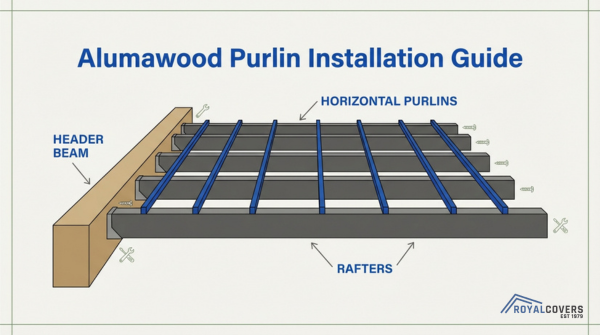
Alumawood purlins are horizontal aluminum members that run perpendicular to the main rafters, supporting roof panels and distributing structural loads across a patio cover. Proper installation requires precise spacing, correct fasteners, and careful frame preparation.
This guide covers purlin types and sizing, tools and safety gear, frame preparation and spacing standards, cutting and attachment techniques, common mistakes to avoid, roof panel integration, and long-term maintenance.
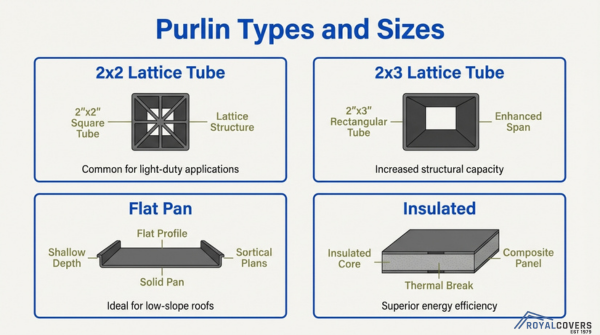
Alumawood purlins come in profiles like 2×2 lattice tubes, 2×3 lattice tubes, flat pan, and insulated styles, each designed to accept a specific panel type. Choosing the wrong profile creates costly mismatches that compromise both fit and weather resistance.
Frame preparation starts with verifying that the header beam is level and square, since even slight deviations compound across the full span. Purlin spacing depends on your system type: lattice covers use tight intervals for shade control, flat pan systems match panel width (typically 36 to 40 inches on center), and insulated systems require exact alignment at each panel joint.
Cutting requires a fine-toothed blade rated for non-ferrous metal, and the factory finish needs protection with painter’s tape and padded work surfaces throughout handling. Attachment relies on purlin clips and Climaseal screws at every rafter intersection, with the first purlin set perfectly square as the reference for all subsequent pieces.
Uneven spacing, over-tightened fasteners, and misaligned first purlins are the most common errors; each leads to panel fit problems and potential structural failure. After installation, twice-yearly fastener inspections and gentle cleaning with water and a soft-bristled brush preserve performance for decades.
What Are Alumawood Purlins and Why Do They Matter?
Alumawood purlins are horizontal aluminum members that run perpendicular to the main rafters, supporting roof panels and providing structural integrity to the patio cover. The sections below cover their purpose and available sizes.
What Is the Purpose of Purlins in an Alumawood Patio Cover?
The purpose of purlins in an Alumawood patio cover is to bridge the gaps between rafters, create attachment points for roof panels, and distribute weight evenly across the structure. Purlins transfer roof loads, including wind and debris, from the panels down through the rafters, header beam, and ledger board into the building’s framework. Without properly installed purlins, roof panels have no stable support and can shift, sag, or detach over time.
Alumawood is made from roll-formed aluminum alloy 3105, embossed with a wood-grain texture and finished with the Aluma-Shield paint system to replicate the look of traditional painted wood, according to They Build Aluminum Inc. This means purlins deliver real structural performance while maintaining a clean, wood-like aesthetic. For homeowners considering a DIY approach, understanding how purlins connect to each rafter is essential before moving to layout and spacing.
What Sizes and Styles Do Alumawood Purlins Come In?
Alumawood purlins come in several standard profiles designed to match different cover types:
- 2×2 lattice tubes suit open pergola and lattice covers where filtered shade is the goal.
- 2×3 lattice tubes provide a wider profile for increased shade density on lattice structures.
- Flat pan purlins are used in solid, non-insulated roof systems where panels slide into purlin channels.
- Insulated purlins accommodate thicker foam-core panels for solid covers that reduce heat transfer.
Each profile has a specific channel width that accepts only its matching roof panel type, so selecting the correct purlin size during planning prevents costly mismatches. Flat pan and insulated styles also differ in how they fasten to rafters, which directly affects the installation steps covered next.
What Tools and Materials Do You Need to Install Alumawood Purlins?
The tools and materials you need to install Alumawood purlins include power tools for cutting and fastening, specific hardware designed for aluminum components, and personal safety equipment. The sections below cover required fasteners and essential safety gear.
What Hardware and Fasteners Are Required for Purlin Installation?
The hardware and fasteners required for purlin installation include Climaseal screws, purlin clips, hex head drivers, and end caps designed specifically for Alumawood systems. According to Try-Tech Industries’ installation instructions, recommended tools for Alumawood patio cover installation include a variable speed drill, hex head drivers, a framing square, a level, a chalk line, and a variable speed jigsaw with appropriate blades for cutting aluminum.
Essential hardware and fasteners include:
- 2″ Climaseal screws for securing purlins to rafters without corroding the aluminum finish.
- Purlin clips to lock purlins onto rafters and maintain consistent spacing.
- 1-1/2″ x 1-1/2″ end caps for capping exposed purlin ends.
- Hex head drivers (5/16″ and 1/4″) compatible with your variable speed drill.
A framing square and chalk line are just as critical as the fasteners themselves, since even minor alignment errors compound across the full span of a patio cover.
What Safety Equipment Should You Have Before Starting?
The safety equipment you should have before starting includes eye protection, work gloves, a stable ladder, and hearing protection. Cutting aluminum with a jigsaw produces sharp metal shavings and noise that demand proper precautions.
Recommended safety gear includes:
- ANSI-rated safety glasses to shield against aluminum shavings during cutting.
- Cut-resistant work gloves to protect hands from sharp aluminum edges.
- Non-slip, stabilized ladder rated for your weight plus materials.
- Hearing protection when operating power saws or jigsaws for extended cuts.
- Closed-toe boots with grip soles for secure footing on elevated surfaces.
Skipping any of these items, particularly eye protection while cutting, creates unnecessary risk on a project that is otherwise straightforward. With the right tools and safety gear gathered, you can move on to preparing the patio cover frame.
How Do You Prepare the Patio Cover Frame Before Adding Purlins?
You prepare the patio cover frame before adding purlins by confirming the header beam is level, the structure is square, and purlin spacing is accurately marked on the rafters. These two preparation steps prevent alignment problems during installation.
How Do You Verify the Header Beam Is Level and Square?
You verify the header beam is level and square by placing a 4-foot level along the top edge of the beam and checking for plumb at each post connection. Measure diagonals corner to corner; equal measurements confirm the frame is square.
Pay close attention where the 2″ x 6-1/2″ rafters extend beyond the header beam. According to Try-Tech Patios, Alumawood rafter tails are the decorative ends of these rafters, often finished with end caps to mimic traditional wood beam cuts. If the header is even slightly out of level, those rafter tails will telegraph the error visually, and purlins will not sit flush across the tops of the rafters.
A framing square pressed into each rafter-to-beam junction catches angular deviations that a level alone can miss. Correcting these issues before marking purlin positions saves significant rework later.
How Do You Measure and Mark Correct Purlin Spacing?
You measure and mark correct purlin spacing by first determining your desired shade percentage, then transferring consistent on-center measurements across all rafters using a chalk line.
Shade coverage drives the spacing decision. According to Heartland Pergolas, purlins spaced at 6 inches on center provide approximately 50% shade, while tighter intervals achieve 75% or 90% coverage. Reviewing Alumawood patio cover ideas before finalizing your shade percentage helps match purlin spacing to your desired design style. Once you select a spacing interval, hook a tape measure at the first rafter’s edge and mark each purlin position. Repeat on the opposite end rafter, then snap chalk lines between corresponding marks to create straight reference lines across the entire span.
For most homeowners, starting from the front fascia edge and working toward the ledger board keeps the visible spacing uniform where it matters most. Double-check at least three intermediate rafters to confirm your chalk lines align with each mark.
With spacing locked in, the frame is ready for purlin installation.
What Is the Correct Purlin Spacing for Alumawood Patio Covers?
The correct purlin spacing for Alumawood patio covers depends on the purlin type, panel width, and whether the roof system is flat pan or insulated. The sections below cover standard flat pan spacing, insulated purlin requirements, and how panel dimensions influence layout.

What Spacing Works Best for Standard Flat Pan Purlins?
The spacing that works best for standard flat pan purlins aligns with the roof panel width used in the system, typically ranging from 36 to 40 inches on center. Each purlin must sit directly beneath a panel joint to support the interlocking seam and prevent sagging between rafters.
For lattice-style covers, spacing changes significantly. According to City of Roseville building standards, lattice tubes are typically spaced at 3 inches on center for 2×2 or 2×4 profiles, with rafter spacing up to 48 inches on center depending on span and snow load requirements. Solid flat pan systems follow wider intervals because the panels themselves carry loads across continuous support channels. Since different types of patio covers use different panel profiles, matching purlin placement to the manufacturer’s panel dimensions is the single most important factor for a weather-tight installation.
What Spacing Is Needed for Insulated Alumawood Purlins?
The spacing needed for insulated Alumawood purlins is determined by the insulated panel width, which is typically 36 inches. Insulated panels are thicker and heavier than standard flat pan panels, so purlins must be positioned precisely at each panel edge to bear the additional weight.
Because insulated roof systems use rigid foam-core panels, there is less flexibility to adjust spacing after the frame is built. Each purlin must align exactly where two insulated panels meet. Deviating even slightly from the panel width creates gaps that compromise both the thermal seal and structural integrity. Homeowners exploring how to insulate an aluminum patio roof should factor purlin placement into their insulation planning from the start. For most insulated Alumawood configurations, planning purlin locations before rafter installation saves significant time and prevents costly rework.
How Does Roof Panel Width Affect Purlin Spacing?
Roof panel width directly determines purlin spacing because each purlin must support a panel edge or interlocking seam. Standard Alumawood flat pan panels and insulated panels come in fixed widths, so purlin placement follows the panel dimensions rather than arbitrary intervals.
When the cover width does not divide evenly by the panel width, one panel must be cut to fit. The cut panel is typically placed against the house wall where the ledger board provides continuous support. This approach keeps all field purlins at uniform spacing while the trimmed panel sits against the most structurally reinforced edge. Measuring total roof width and dividing by panel width before marking purlin locations prevents misalignment across the entire structure.
With spacing established, the next step is cutting purlins to the correct length.
How Do You Cut Alumawood Purlins to the Right Length?
You cut Alumawood purlins to the right length by measuring the exact span between rafters, marking a square cut line, and using a fine-toothed blade designed for aluminum. The sections below cover blade selection and finish protection.
What Blade Type Should You Use to Cut Alumawood?
The blade type you should use to cut Alumawood is a fine-toothed blade rated for non-ferrous metal. According to Try-Tech Industries, recommended tools for Alumawood patio cover installation include a variable speed jigsaw with appropriate blades for cutting aluminum.
Key blade selection criteria include:
- A carbide-tipped blade with 10 or more teeth per inch minimizes burrs on aluminum alloy profiles.
- A variable speed jigsaw set to a lower speed gives you more control through the thin-walled purlin material.
- Circular saw blades designed for non-ferrous metal work for straight crosscuts on longer purlins.
Avoid standard wood blades. Their coarse tooth count tears aluminum rather than shearing it cleanly, which creates jagged edges that compromise both fit and safety.
How Do You Prevent Scratching or Damaging the Finish?
You prevent scratching or damaging the finish by protecting the Aluma-Shield paint system throughout every cutting and handling step. Alumawood purlins feature an embossed wood-grain texture that shows scratches easily against the coated surface.
Effective finish protection techniques include:
- Apply painter’s tape along both sides of the cut line to shield the painted surface from blade contact and metal shavings.
- Place purlins on a padded work surface, such as a moving blanket, to prevent scuffing during measurement and cutting.
- Wear clean, non-abrasive gloves when handling cut pieces to avoid fingerprint etching on the coated aluminum.
- Deburr cut edges with a fine file or sandpaper before test-fitting, since rough edges can gouge adjacent purlin surfaces during assembly.
Taking these precautions during cutting makes the attachment process smoother and preserves the factory finish long term.
How Do You Attach Alumawood Purlins Step by Step?
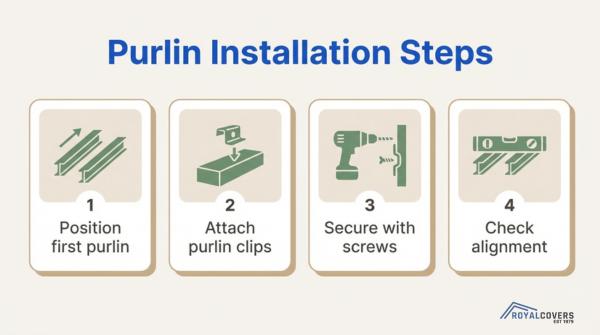
You attach Alumawood purlins step by step by positioning the first purlin flush against the ledger or fascia, securing each one with clips and screws at every rafter intersection, and checking alignment as you go. The following steps cover positioning, fastening, alignment, and corner connections.
How Do You Position the First Purlin Correctly?
You position the first purlin correctly by setting it flush against the fascia board or ledger board at the starting edge of the structure. Use a framing square to confirm the purlin sits at a perfect 90-degree angle to the rafters. This reference purlin establishes the baseline for all subsequent spacing, so even a small deviation here compounds across the entire roof. Mark its exact location on each rafter with a chalk line before fastening. Getting this first piece dead-level and square is the single most important step in the entire purlin installation process.
How Do You Secure Purlins to the Main Beam and Rafters?
You secure purlins to the main beam and rafters using purlin clips and self-tapping screws at each rafter intersection. According to LB Structural, purlin clips are specialized fasteners that secure lattice tubes or purlins to the main rafters, ensuring stable positioning and maintaining consistent spacing throughout the structure. At each connection point:
- Slide the purlin clip over the rafter flange at the marked location.
- Seat the purlin into the clip channel so it rests flat and square.
- Drive self-tapping screws through the clip into the rafter to lock the assembly.
Every rafter crossing requires its own clip; skipping even one creates a weak point that allows movement under wind or snow loads.
How Do You Ensure Each Purlin Stays Aligned During Install?
You ensure each purlin stays aligned during install by using a chalk line snapped across the rafters as a continuous visual reference. After securing the first purlin, measure your target spacing from its edge and snap a parallel chalk line for the next one. A speed square held against the rafter confirms perpendicularity at each clip point. Checking alignment every three to four purlins prevents cumulative drift. If a purlin shifts before its clips are tightened, loosen and reposition it rather than forcing the next piece to compensate. Consistent spacing ensures roof panels seat properly without binding or gaps.
How Do You Handle Inside and Outside Corner Connections?
You handle inside and outside corner connections by mitering purlin ends at 45 degrees where two roof planes meet. Cut each mating purlin so the mitered faces sit flush against one another, forming a clean joint with no visible gap. Use a corner bracket or an additional purlin clip at the junction to reinforce the connection, since corner joints bear lateral stress from both roof sections. Seal the joint with a color-matched caulk to prevent moisture intrusion at the seam. Properly executed corners maintain the structure’s visual continuity and prevent the weak points that lead to panel misalignment.
With purlins secured and aligned, recognizing common installation mistakes helps protect your finished work.
What Are the Most Common Purlin Installation Mistakes to Avoid?
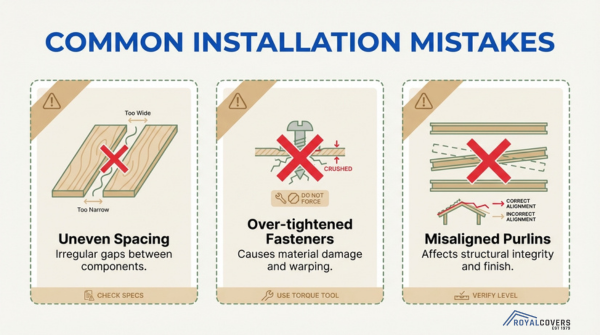
The most common purlin installation mistakes to avoid are uneven spacing, over-tightened fasteners, and misaligned purlins. Each of these errors compromises structural integrity and roof panel fit.
What Happens If Purlins Are Spaced Unevenly?
Purlins spaced unevenly create gaps and pressure points that compromise the entire roof system. When spacing varies from one bay to the next, roof panels cannot seat properly in the purlin channels, leading to buckled panels, visible waviness, and potential water intrusion at loose joints.
Uneven spacing also distributes load inconsistently across the rafters. Some purlins bear more weight than designed while others carry less, which accelerates wear on fasteners and can cause sagging over time. According to data from HomeGuide, professional repair costs for improper Alumawood installation average $1,599, ranging from $726 to $2,583.
Using a chalk line and measuring from a fixed reference point at each rafter prevents this problem entirely.
Why Does Over-Tightening Fasteners Cause Problems?
Over-tightening fasteners causes problems because excessive torque strips the threads in aluminum, cracks purlin walls, and crushes the profile at connection points. Alumawood components are formed from aluminum alloy, which is softer than steel; what feels snug on a wood project can be destructive on aluminum.
Stripped screw holes lose their holding strength permanently. A variable speed drill set to low torque gives far better control than a high-speed impact driver. The fastener should be firm enough to eliminate movement without dimpling or deforming the surrounding material. When the screw head sits flush and the purlin no longer shifts, stop. That extra quarter-turn is where most damage occurs.
How Do Misaligned Purlins Affect Roof Panel Fit?
Misaligned purlins affect roof panel fit by preventing panels from sliding smoothly into the channel tracks. Even a small deviation, as little as 1/8 inch over several feet, forces panels to bind, bow, or leave gaps that allow water and debris infiltration.
Misalignment typically starts at the first purlin. If that initial piece is off-square relative to the header beam, every subsequent purlin amplifies the error. Checking alignment with a framing square at the first and last rafter connection catches drift before it compounds.
For most DIY installers, this is the single most consequential mistake to watch for, since panel fit issues are difficult to correct without removing and repositioning multiple purlins.
With common mistakes identified, attaching roof panels to properly installed purlins becomes straightforward.
How Do You Attach Roof Panels to the Purlins After Installation?
You attach roof panels to purlins by sliding them into the purlin channels and then sealing all joints for weather protection. The following sections cover panel insertion technique and joint sealing.
How Do You Slide Panels Into the Purlin Channels?
You slide panels into the purlin channels by feeding each panel’s edge into the channel groove at one end of the structure and pushing it across the full span until it locks into position. Starting from the side closest to the house wall keeps alignment consistent. Each panel should engage the channel lip on both the leading and trailing purlin before the next panel is introduced. Maintaining even pressure during the slide prevents the panel from binding or scratching the factory finish. If a panel resists, checking that purlins are parallel and level usually resolves the issue. Properly seated panels sit flush with no visible gaps along the channel edge.
How Do You Seal Joints Between Panels for Weather Protection?
You seal joints between panels for weather protection by applying weatherproof sealant or inserting factory gaskets along every panel-to-panel seam. Alumawood solid roof systems rely on tight interlocking joints, but sealant at overlapping edges adds a critical moisture barrier against wind-driven rain. Running a continuous bead of exterior-grade silicone along each seam before snapping the next panel in place traps no moisture underneath. According to Royal Covers, common installation mistakes for Alumawood patio covers can lead to water leaks and structural issues, with professional repair costs for improper installation averaging $1,599. Investing time in proper sealing during initial assembly prevents costly corrections later. With panels secured and sealed, routine maintenance keeps the entire system performing well.
How Should You Maintain Alumawood Purlins After Installation?
You should maintain Alumawood purlins after installation through regular fastener inspections and gentle cleaning. These two practices preserve structural integrity and protect the factory finish for decades.
How Often Should You Inspect Purlin Fasteners and Connections?
You should inspect purlin fasteners and connections at least twice per year, ideally before and after the most demanding weather season in your area. Alumawood lattice tubes are secured to 2×6 rafters using 2″ Climaseal screws with end caps fitted to each tube, according to Alumawood Factory Direct installation guidelines. Over time, thermal cycling can loosen these connections.
During each inspection, check for:
- Screws that have backed out or feel loose when tested with a hex driver.
- End caps that have shifted, cracked, or detached from purlin tubes.
- Purlin clips showing signs of corrosion or deformation at rafter contact points.
- Any visible movement or rattling when moderate upward pressure is applied to individual purlins.
Tighten loose Climaseal screws to their original snug position without over-torquing, which can strip the aluminum. Catching small fastener issues early prevents the cascading misalignment problems that lead to costly structural repairs.
What Is the Best Way to Clean Alumawood Purlins?
The best way to clean Alumawood purlins is with clear water from a garden hose and a soft-bristled brush, such as a long-handled car-washing brush, as recommended by Alumawood Outdoor Living. This gentle approach removes dust, pollen, and light debris without damaging the Aluma-Shield paint finish.
For stubborn buildup, follow these steps:
- Rinse the entire purlin surface with moderate hose pressure to remove loose dirt.
- Apply a mild soap solution safe for bare hands, such as a standard car wash product.
- Scrub gently along the wood-grain embossing pattern using the soft-bristled brush.
- Rinse thoroughly from top to bottom to prevent soap residue from drying on the finish.
Avoid pressure washers, abrasive pads, and solvent-based cleaners, which can strip the protective coating. Cleaning once or twice annually keeps purlins looking new. Once your structure is properly maintained, you may also want to hang shades on Alumawood patio covers for additional sun control and privacy. Consistent maintenance routines like these make professional-level results easier to sustain over time.
When Should You Hire a Professional for Alumawood Purlin Installation?
You should hire a professional for Alumawood purlin installation when your project involves code compliance, structural load calculations, or complex framing configurations. The sections below cover what Royal Covers offers and the key takeaways from this guide.
Can Royal Covers Design and Install a Complete Alumawood Patio Cover?
Yes, Royal Covers can design and install a complete Alumawood patio cover. As a licensed, bonded, and insured contractor serving Phoenix since 1979, Royal Covers handles every phase of the project, from custom design consultation and HOA approvals through professional installation with full-time, trained crews.
Professional installation matters most when building codes demand precision. According to 2015 California Building Code standards, Alumawood structures must handle roof snow loads up to 30 psf, with patio units requiring a minimum of 10 psf and commercial units requiring 20 psf minimum. Navigating these structural requirements, along with correct purlin spacing, ledger board attachment, and permit documentation, is where experienced installers prevent costly mistakes.
Professional Alumawood patio cover installation typically costs between $18 and $55 per square foot. For most homeowners, that investment pays for itself by eliminating the rework and repair expenses that follow improper DIY installation.
What Are the Key Takeaways About Installing Alumawood Purlins?
The key takeaways about installing Alumawood purlins center on precision, proper spacing, and code-compliant fastening. The most important lessons from this guide include:
- Purlin spacing directly controls shade coverage and structural integrity; even small deviations cause panel fit problems and uneven load distribution.
- Correct fastener selection and torque prevent cracked aluminum profiles, stripped threads, and long-term loosening.
- Frame preparation, including verifying the header beam is level and square, determines whether purlins align consistently across the entire span.
- Cutting Alumawood requires the right blade type and careful handling to preserve the factory finish.
- Routine inspection of fastener connections and occasional cleaning with water and a soft-bristled brush keeps the structure performing for decades.
For homeowners comfortable with precise measurements and basic aluminum fabrication, purlin installation is a manageable DIY project. When structural complexity, building permits, or load engineering enters the picture, partnering with an experienced installer like Royal Covers ensures the job meets code and lasts.