

Installing an Alumawood downspout is the process of connecting a 2″x3″ aluminum drainage tube from your patio cover’s built-in gutter to ground level, channeling rainwater away from your structure’s foundation.
This guide covers tool preparation, gutter outlet cutting and sealing, downspout assembly and mounting, drainage testing, and long-term maintenance.
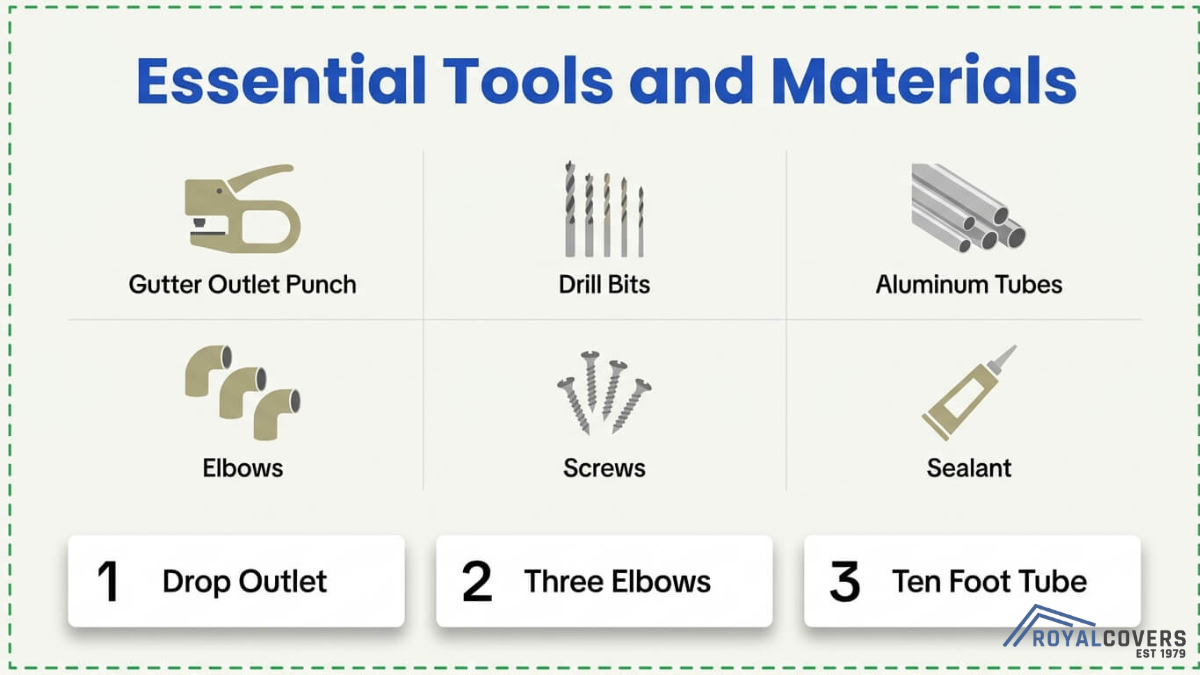
Proper preparation requires a specific kit (drop outlet, three elbows, a 10-foot aluminum tube, screws, and plugs) along with specialized cutting tools like a gutter outlet punch and fine-toothed metal saw. Positioning depends on your cover’s length; most residential installations need one downspout for every 15 to 20 feet of patio cover.
Cutting and attaching the gutter outlet involves punching a precise hole in the gutter bottom, securing the drop outlet flange with sheet metal screws, and sealing joints with tripolymer sealant that maintains flexibility in outdoor environments.
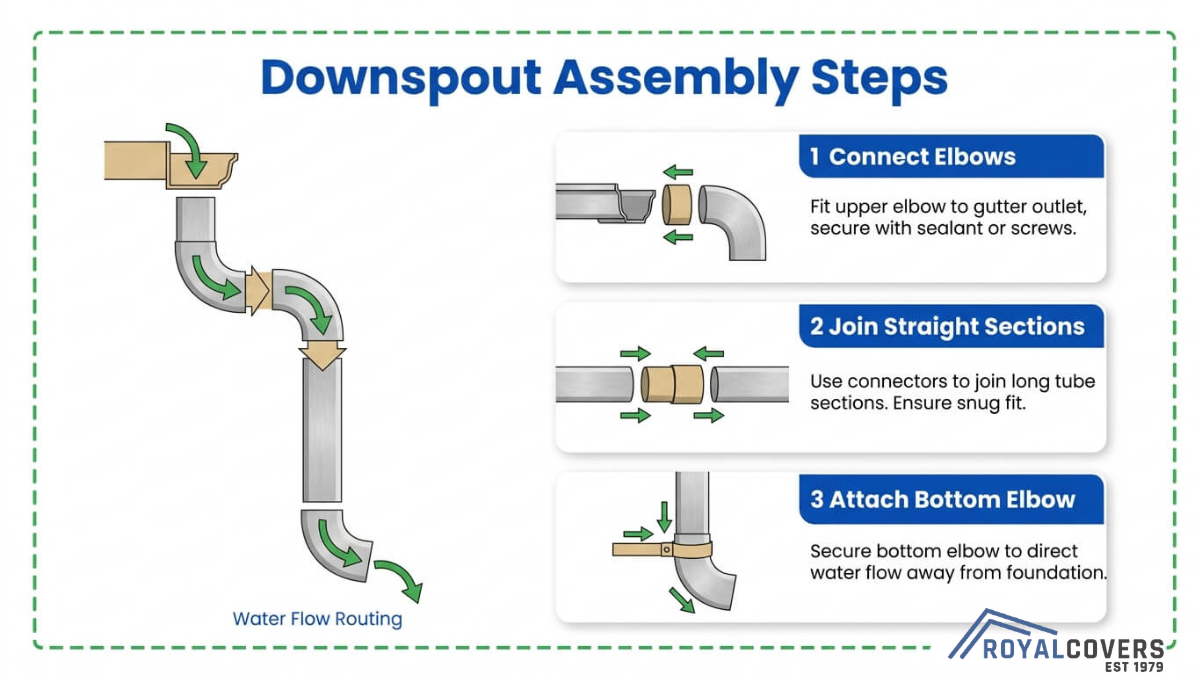
Assembly follows a logical sequence: elbows transition the flow from the gutter outward to the wall, straight sections overlap with crimped ends facing down so water passes over seams, and a final elbow at the base directs discharge away from the foundation.
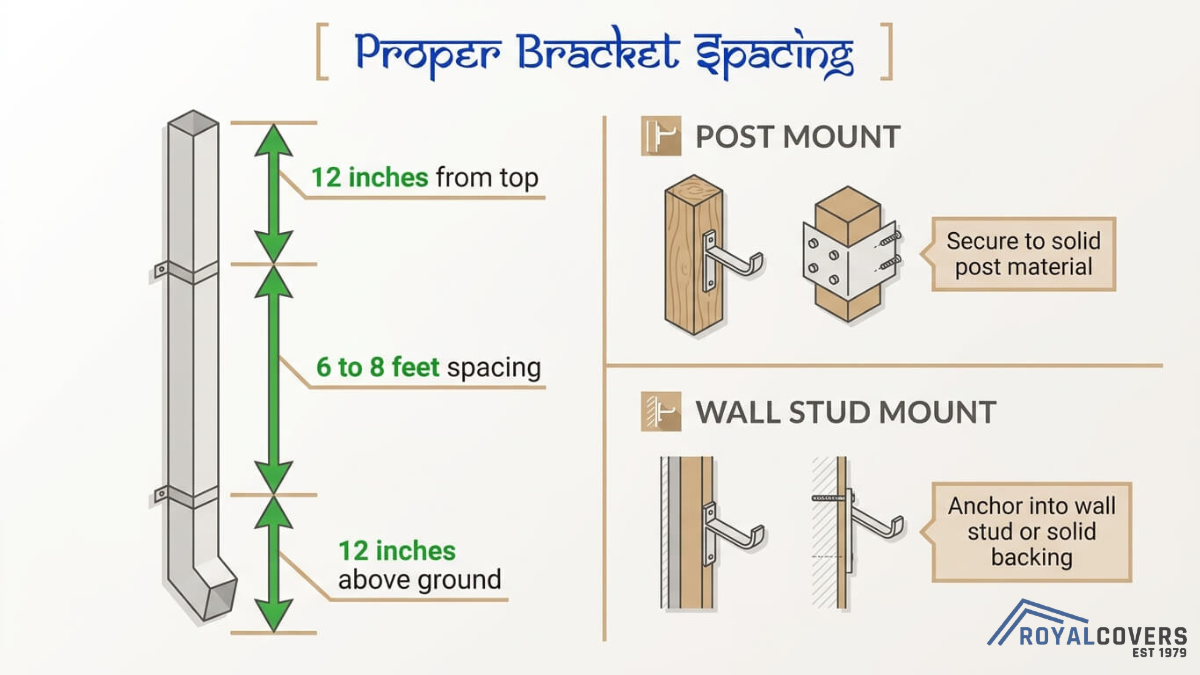
Mounting requires brackets anchored into solid structural material, whether that is an Alumawood post’s internal frame or wall studs behind stucco, spaced at 12 inches from the top elbow, every 6 to 8 feet along vertical runs, and 12 inches above ground.
Testing with a garden hose reveals pooling, leaks, or insufficient slope before the next storm. Ongoing maintenance (biannual flushing, sealant inspections, and avoiding aftermarket coatings) preserves both drainage performance and the factory finish warranty.
What Tools and Materials Do You Need to Install an Alumawood Downspout?
The tools and materials you need to install an Alumawood downspout include a standard downspout kit, drill bits, cutting tools, and sealant. Here is what to gather before starting.
A standard Alumawood downspout kit includes the following components:
- A 2″x3″ drop outlet
- Three elbows
- A 10-foot stick of 2″x3″ aluminum tube
- Screws and 5/8″ plastic plugs
According to Patio Kits Direct, the required tools for Alumawood patio cover installation include a 1/2″ hole saw, 1/8″ and 5/16″ drill bits, hex head drivers, tin snips, and a fine-toothed saw for metal. A Malco gutter outlet punch is also recommended, since it creates clean, accurate hole cuts in aluminum gutter material up to .032 inches thick.
For sealing connections, professionals recommend Geocel 2320 tripolymer sealant because it maintains flexibility and durability in outdoor environments. A tape measure, level, and pencil round out the essentials for accurate layout and alignment. Having everything staged before you begin prevents unnecessary interruptions during installation, which keeps the project moving efficiently from preparation through final testing.
How Do You Prepare Your Alumawood Patio Cover for Downspout Installation?
You prepare your Alumawood patio cover for downspout installation by determining placement, marking the gutter outlet location, and taking precise measurements. The following steps cover positioning, marking, and measuring.
Where Should You Position the Downspout on Your Alumawood Cover?
You should position the downspout on your Alumawood cover at the lowest point of the gutter run, typically at one end near a post or wall for clean routing. According to Alumawood Products, downspouts should be installed at intervals of one for every 15 to 20 feet of patio cover to ensure adequate water management.
Key positioning considerations include:
- Place the drop outlet where water naturally collects at the gutter’s low point.
- Route the downspout along a post or wall corner for a concealed appearance.
- Position the first bracket 12 inches below the top elbow, with middle brackets every 6 to 8 feet.
- Keep the final bracket 12 inches above ground level.
For most residential Alumawood covers under 20 feet, a single downspout at one end handles drainage effectively.
How Do You Locate and Mark the Gutter Outlet Hole?
You locate and mark the gutter outlet hole by identifying the gutter’s lowest collection point and tracing the drop outlet fitting directly onto the gutter bottom. Center the 2″x3″ outlet template on the gutter trough, ensuring it aligns with your planned downspout path below.
A Malco gutter outlet punch makes clean, accurate cuts in aluminum gutter material up to .032 inches thick, which matches standard Alumawood gutter gauges. Mark the outline with a fine-tip marker, then confirm the marked position does not interfere with any structural screws or panel seams before cutting.
What Measurements Do You Need Before Cutting?
The measurements you need before cutting are the distance from the gutter bottom to the wall or post, the offset distance between the gutter edge and the mounting surface, and the total vertical run to ground level. These three dimensions determine how you cut elbow angles and straight tube lengths.
Measure each dimension twice using a tape measure, and record them before making any cuts. Accounting for the 2″x3″ elbow overlap at each connection point prevents sections from running short.
With accurate measurements confirmed, you can proceed to cutting and attaching the gutter outlet.
How Do You Cut and Attach the Gutter Outlet to the Alumawood Gutter?
You cut and attach the gutter outlet by punching a precise hole in the gutter bottom, securing the drop outlet fitting with screws, and sealing all connections. The following steps cover hole cutting, fitting attachment, and leak prevention.

How Do You Cut the Outlet Hole in the Gutter?
You cut the outlet hole in the gutter using a gutter outlet punch or tin snips to create a clean opening that matches the 2″x3″ drop outlet dimensions. According to Malco Tools, gutter outlet punches make clean, accurate hole cuts in aluminum gutter material up to .032 inches (0.81 mm) in thickness.
To cut the outlet hole:
- Position the gutter bottom-side up on a stable work surface.
- Center your pre-marked outline directly over the planned drainage point.
- Use the outlet punch or carefully cut along the traced line with aviation snips.
- File any rough edges to ensure a flush fit against the drop outlet flange.
For thin Alumawood gutters, a punch tool produces cleaner results than manual cutting, since jagged edges can compromise the seal later.
How Do You Secure Drop Outlet Fitting?
You secure the drop outlet fitting by inserting it through the cut hole from below and fastening it with sheet metal screws or pop rivets through the flange. Position the outlet so its flange sits flat against the gutter bottom with no gaps.
Steps to secure the fitting:
- Slide the drop outlet up through the hole until the flange rests flush against the gutter interior.
- Drill pilot holes through the flange and gutter using a 1/8″ drill bit.
- Drive short sheet metal screws into each pilot hole to lock the outlet in place.
- Verify the outlet hangs plumb by holding a level against it.
A snug, gap-free connection between flange and gutter is critical; even slight misalignment creates pooling points where water backs up.
How Do You Seal the Outlet Connection to Prevent Leaks?
You seal the outlet connection to prevent leaks by applying a tripolymer gutter sealant around the flange-to-gutter joint, both inside and outside the connection. According to Bob Vila, professional installers recommend Geocel 2320 tripolymer sealant for aluminum gutters because it maintains flexibility and durability in outdoor environments.
Apply sealant as follows:
- Run a continuous bead along the interior seam where the flange meets the gutter bottom.
- Smooth the bead with a gloved finger to eliminate air pockets.
- Apply a secondary bead along the exterior joint for added protection.
- Allow full cure time before running water through the system.
Silicone-only sealants tend to peel from aluminum over time, making tripolymer formulations the more reliable long-term choice for this application.
With the outlet sealed and secure, connecting the elbow and downspout sections comes next.
How Do You Assemble and Connect the Alumawood Downspout Sections?
You assemble and connect Alumawood downspout sections by cutting aluminum tube to length, joining elbows at transition points, overlapping straight sections, and attaching a final elbow at the base.
How Do You Cut Downspout Sections to the Correct Length?
You cut downspout sections to the correct length by measuring the distance between connection points, marking the 2″x3″ aluminum tube, and using a fine-toothed metal saw or tin snips for a clean edge. Measure from the bottom of the upper elbow to the top of the lower elbow, subtracting approximately 1.5 inches for overlap at each joint. Deburr cut edges with a file to prevent snags and ensure tight connections. Precision here prevents gaps that could leak during heavy rain.
How Do You Connect Elbows to Transition from Gutter to Wall?
You connect elbows to transition from gutter to wall by attaching two elbows in sequence below the drop outlet. The first elbow angles outward from the gutter, and the second elbow redirects downward toward the wall or post. A short connecting piece of downspout tube bridges the two elbows. Downspouts are vertical pipes that channel water from gutters to the ground, according to Arizona Roofers, so these elbows create the necessary offset to bring the vertical run flush against the mounting surface.
How Do You Join Straight Downspout Sections Together?
You join straight downspout sections together by overlapping the crimped (narrower) end of one section into the wider end of the next. Insert the upper piece into the lower piece so water flows over the seam rather than into it. Secure each joint with two self-tapping sheet metal screws on opposite sides. This overlap method prevents leaks at joints while allowing thermal expansion in the aluminum.
How Do You Attach the Final Elbow at the Bottom?
You attach the final elbow at the bottom by sliding it onto the last straight downspout section and angling it away from the structure’s foundation. Secure the connection with two screws. The elbow should direct water at least 4 to 6 feet from the base of the post or wall to prevent pooling and soil erosion. For best results, pair the bottom elbow with a splash block or extension to guide discharge safely across the landscape.
With all sections connected, the next step is mounting the assembled downspout securely.
How Do You Mount the Alumawood Downspout to the Post or Wall?
You mount the Alumawood downspout to the post or wall using brackets secured into solid structural material. The method varies depending on your mounting surface.
How Do You Install Downspout Brackets on an Alumawood Post?
You install downspout brackets on an Alumawood post by pre-drilling pilot holes with a 1/8″ bit and driving stainless steel screws through the bracket into the post’s internal structure. Position the bracket snugly around the 2″x3″ downspout tube, ensuring the screw penetrates into the post’s aluminum frame rather than just the outer shell. Apply Geocel 2320 tripolymer sealant around screw penetrations; professional installers recommend this product because it maintains flexibility and durability in outdoor environments, according to Northstar Gutter’s installation guide. For post-mounted runs, this approach eliminates the need to locate wall studs, making it the simpler of the two methods.
How Do You Install Downspout Brackets on a Stucco Wall?
You install downspout brackets on a stucco wall by first locating structural studs behind the stucco surface. According to Alumashade’s technical specifications, installers must drill pilot holes above the ledger line to confirm solid wood contact rather than just plywood sheeting. Use a masonry bit to penetrate the stucco layer, then switch to a standard bit to verify wood framing behind it. Secure brackets with lag screws or tapcon fasteners rated for the combined stucco and framing thickness. Failing to anchor into studs risks bracket pull-out under the weight of water-filled downspouts during heavy rain.
How Do You Space Brackets for Secure Downspout Support?
You space brackets for secure downspout support by following a three-point placement pattern:
- Place the first bracket 12 inches below the top elbow connection.
- Install middle brackets every 6 to 8 feet along straight vertical runs.
- Position the final bracket 12 inches above the ground or bottom elbow.
This spacing prevents the downspout from bowing, rattling in wind, or separating at joints. Runs shorter than 6 feet still require a minimum of two brackets for stability. Tighter spacing may be warranted in areas prone to high winds or where the downspout carries heavy water volume from larger roof sections.
With brackets secured, testing the system confirms everything drains properly.
What Common Mistakes Should You Avoid During Alumawood Downspout Installation?
The common mistakes you should avoid during Alumawood downspout installation include painting over factory finishes, skipping sealant at connections, improper bracket spacing, and neglecting slope requirements.
- Applying field-applied paint or coatings. According to Alumawood manufacturer guidelines, homeowners should avoid applying field-applied paint or coatings to Alumawood components to maintain the factory finish warranty.
- Skipping sealant at the outlet connection. Unsealed joints allow water to drip behind the gutter, causing moisture damage over time.
- Spacing brackets too far apart. Unsupported sections sag, pull away from the mounting surface, and create pooling points.
- Ignoring minimum slope requirements. Without adequate pitch toward the outlet, water sits in the gutter rather than flowing into the downspout.
- Failing to confirm solid backing when mounting to stucco. Brackets fastened only into plywood sheeting will loosen under wind and water load.
For most DIY installers, the warranty violation from painting is the costliest oversight because it voids coverage entirely with no recourse. Testing drainage thoroughly after installation helps catch several of these errors before they cause lasting damage.
How Do You Test Your Alumawood Downspout for Proper Drainage?
You test your Alumawood downspout for proper drainage by running water through the system and observing flow speed, leak points, and discharge direction.
To confirm your installation works correctly, follow this process:
- Pour a steady stream of water from a garden hose into the gutter at the farthest point from the downspout.
- Watch for pooling or slow movement along the gutter, which indicates insufficient slope.
- Inspect every elbow joint and the drop outlet connection for drips or seepage.
- Verify that water exits the bottom elbow cleanly and directs at least 4 to 6 feet away from the foundation.
- Check that the downspout handles the full flow without backing up or overflowing at the gutter.
According to Valley Patios, Alumawood engineering specifications require a minimum roof slope of 1/4 inch per foot for proper drainage, though 3/8 to 1/2 inch per foot is often used for better performance. If water pools in your gutter during testing, the slope likely falls below this threshold.
A standard 2″x3″ rectangular downspout manages drainage for up to 600 square feet of roof area under standard rainfall conditions. If your patio cover exceeds this coverage, a single downspout will overflow during heavy storms regardless of proper installation. For most residential Alumawood covers, testing with a garden hose at full pressure simulates moderate rainfall well enough to reveal any weak points before the next storm arrives.
How Do You Maintain an Alumawood Downspout After Installation?
You maintain an Alumawood downspout after installation through regular cleaning, periodic inspections, and proper care of the factory finish. The following steps cover cleaning methods, inspection schedules, and finish preservation.
Routine maintenance starts with flushing the downspout with a garden hose at least twice per year to clear accumulated debris. During monsoon season or periods of heavy leaf fall, increase this frequency. Check each bracket and screw connection for looseness, since thermal expansion cycles can gradually work fasteners free over time.
For heavy dirt accumulation on Alumawood surfaces, manufacturers recommend a solution of 1/3 cup detergent, 2/3 cup trisodium phosphate (TSP), and 1 gallon of water, according to Alumawood Products. Apply with a soft cloth or sponge, then rinse thoroughly.
Inspect the sealant around the gutter outlet connection annually. Cracked or separated sealant allows water to bypass the downspout entirely, which defeats the purpose of the drainage system. Reseal any compromised joints promptly.
To maintain the factory finish warranty, homeowners should avoid applying field-applied paint or coatings to Alumawood components. The baked-on Aluma-Shield paint system already resists peeling, fading, and chalking, so aftermarket coatings are unnecessary and may void coverage.
Key maintenance tasks include:
- Flushing downspouts with a hose at least twice annually to prevent clogs.
- Tightening brackets and fasteners that loosen from thermal cycling.
- Inspecting sealant joints at the gutter outlet for cracks or separation.
- Cleaning surfaces with the manufacturer-recommended TSP solution for stubborn buildup.
- Avoiding aftermarket paints or coatings that could void the factory finish warranty.
- Confirming that discharge water still flows 4 to 6 feet away from the foundation.
Consistent seasonal maintenance is one of the most overlooked steps in preserving a drainage system’s performance; even well-installed downspouts fail when neglected. With proper upkeep confirmed, the next consideration is whether professional installation makes sense for your project.
Should You Hire a Professional for Alumawood Downspout Installation?
You should hire a professional when your project involves building code compliance, multi-story structures, or complex drainage routing. The sections below cover how Royal Covers can help and the key installation takeaways.
Can Royal Covers Handle Your Alumawood Patio Cover and Drainage Needs?
Yes, Royal Covers can handle your Alumawood patio cover and drainage needs. Founded in 1979, Royal Covers specializes in designing and installing Alumawood patio covers engineered for Arizona’s desert climate. Royal Covers employs full-time, continuously trained installation teams rather than subcontractors, ensuring proper gutter integration, downspout placement, and code-compliant drainage from the start.
Professional installation matters because the California Residential Code Appendix H limits patio covers to one-story structures not exceeding 12 feet in height, and similar municipal standards apply across jurisdictions. Navigating these requirements, along with HOA approvals and permit paperwork, is something Royal Covers manages as part of every project. Alumawood’s baked-on Aluma-Shield paint system with a Teflon additive resists peeling, fading, and chalking, but preserving that factory finish requires proper handling during installation. Royal Covers offers free design consultations and a 2-year workmanship warranty on all installations.

What Are the Key Takeaways About Installing an Alumawood Downspout?
The key takeaways about installing an Alumawood downspout center on preparation, precision, and proper drainage routing:
- Position one downspout for every 15 to 20 feet of patio cover length.
- Maintain a minimum roof slope of 1/4 inch per foot for adequate water flow.
- Place the first bracket 12 inches below the top elbow and space middle brackets every 6 to 8 feet.
- Seal all outlet connections with flexible tripolymer sealant to prevent leaks.
- Direct discharge at least 4 to 6 feet from the foundation to avoid structural damage.
- Avoid field-applied paint or coatings to preserve the factory finish warranty.
For homeowners comfortable with basic tools, this project is manageable as a weekend DIY task. For complex layouts or code-sensitive situations, working with a professional like Royal Covers ensures long-term performance.