
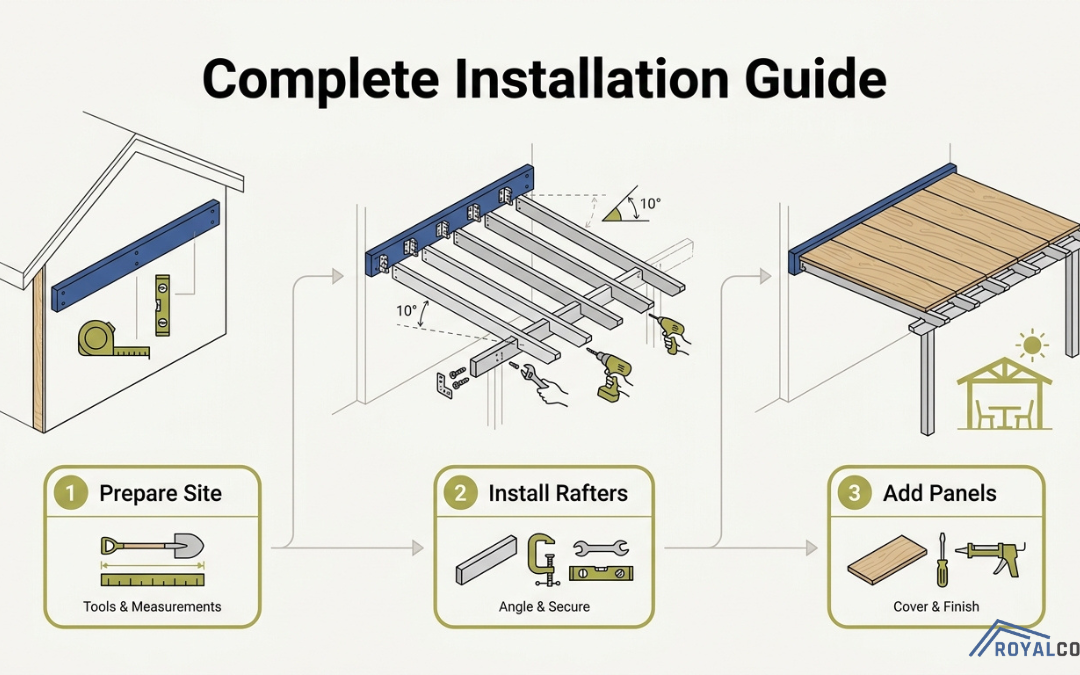
Installing Alumawood rafters is the process of securing lightweight aluminum extrusions to a ledger board and header beam at precise intervals to form the structural framework of a patio cover. Proper installation requires specific hardware, correct spacing, adequate slope, and weatherproof connections at every attachment point.
This guide covers tools and site preparation, measuring and cutting techniques, attachment methods for both the ledger and header beam, support hardware and roof panel installation, common mistakes to avoid, and long-term maintenance.
Alumawood systems require specialized fasteners for each connection type, including lag screws for ledger attachment, stainless steel anchors for concrete, and self-drilling screws for aluminum-to-aluminum joints. Site preparation demands a verified ledger board made from Douglas Fir #2 or better, with post placement confirmed at 24-inch on-center intervals.
Cutting rafters cleanly requires a TCG carbide-tipped blade with 80 to 100 teeth, paired with protective tarps and painter’s tape to shield the factory powder-coated finish from damage during handling.
Attachment involves securing rafters at both the ledger board and front header beam while maintaining a minimum slope of 1/4-inch per foot for proper water drainage. Every fastener penetrating the header requires sealing washers and caulk to create weathertight connections.
Common installation failures stem from exceeding specified rafter spacing, insufficient slope causing water pooling, and over-tightening fasteners beyond aluminum’s compression tolerance. Avoiding these errors helps properly installed covers achieve their projected 30+ year lifespan with only occasional washing for maintenance.
What Tools and Materials Do You Need to Install Alumawood Rafters?
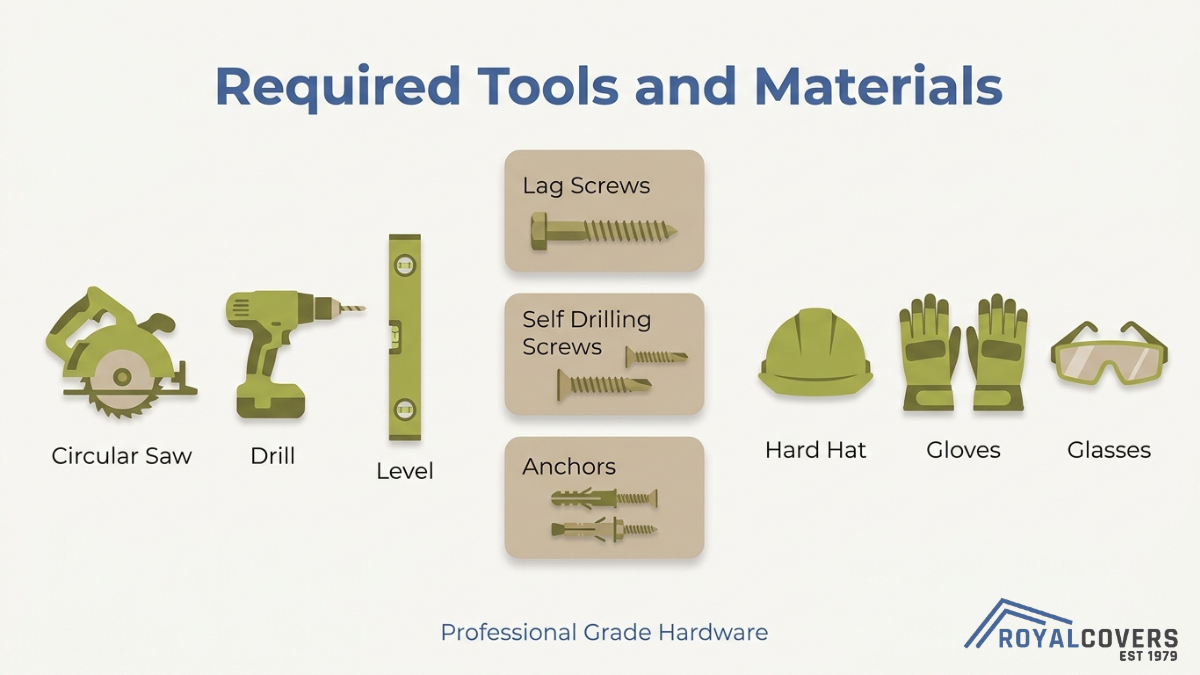
You need structural fasteners, power tools, protective materials, and safety equipment to install Alumawood rafters correctly. The following sub-sections cover required hardware and essential safety gear.
What Structural Hardware Is Required for Alumawood Rafters?
The structural hardware required for Alumawood rafters includes fasteners specific to each connection point in the system. According to Amerimax Exterior Home Products, structural hardware for Alumawood systems includes 1/4″x5″ lag screws for ledger attachment, 3/8″x3.5″ stainless steel Hilti Kwik Bolt II anchors for concrete, and #14×3/4″ self-drilling screws for post-to-header connections.
Protective tarps must be placed beneath aluminum components during installation, as the factory paint finish scratches easily on rough surfaces. Skipping this step creates cosmetic damage that cannot be repaired without refinishing entire panels.
What Safety Equipment Should You Have on Hand?
The safety equipment you should have on hand includes fall protection, eye protection, and hand protection appropriate for working at height with metal components. Essential items include:
- A sturdy ladder or scaffolding rated for your weight plus materials
- Safety glasses to guard against metal shavings during cutting and drilling
- Work gloves to prevent cuts from aluminum edges
- Hearing protection when operating power saws
- Non-slip footwear for roof or ladder work
Because Alumawood installations involve overhead fastening and power tools, having a spotter or helper nearby reduces the risk of falls and simplifies rafter alignment during attachment.
How Do You Prepare the Installation Site for Alumawood Rafters?
You prepare the installation site for Alumawood rafters by verifying the ledger board, confirming post placement, and securing any required building permits.
How Do You Verify the Ledger Board Is Level and Secure?
You verify the ledger board is level and secure by checking it with a 4-foot level across its full length and confirming it is fastened to structural framing with proper lag screws. The ledger board must be a 2″x8″ Douglas Fir #2 or better (1.5″x7.5″ true size), according to Alumawood Factory Direct installation specifications. Pressed board, OSB, and particle board are strictly prohibited for this structural component.
Before mounting any rafters, confirm the ledger shows no deflection under hand pressure and that all attachment points align with wall studs or a solid rim joist. Even a slight bow in the ledger will compound across multiple rafter connections, creating uneven panel seating down the line.
How Do You Confirm Post Placement Matches Rafter Spacing?
You confirm post placement matches rafter spacing by measuring from center-to-center on your posts and verifying alignment with your planned rafter layout. According to a Duralum Products engineering report, rafter spacing for lattice structures is typically set at 24 inches on-center, while rafter overhangs are limited to a maximum of 25% of the clear span or 36 inches, whichever is less.
To verify alignment:
- Measure from the ledger board to each post to confirm equal projection distances.
- Check that post centers correspond to beam splice points or rafter locations.
- Use a string line across post tops to confirm they sit in a straight plane.
Misaligned posts force rafters into awkward positions, creating stress points that compromise long-term structural performance.
What Building Permits Are Needed Before Installation?
The building permits needed before installation vary by jurisdiction, structure size, and whether the patio cover attaches to your home. California building codes generally require a permit for any patio cover exceeding 120 square feet. However, the Florida Building Code requires a permit for all attached patio covers regardless of size, as they must resist lateral loads.
Key factors that determine permit requirements:
- Total projected roof area of the planned cover.
- Whether the structure is freestanding or attached to the dwelling.
- Local zoning setback requirements from property lines.
- HOA architectural review approvals, if applicable.
Skipping the permit process risks costly tear-downs and complicates future home sales. With permits secured, you can confidently move to measuring and marking rafter positions.
How Do You Measure and Mark Rafter Spacing Correctly?
You measure and mark rafter spacing correctly by establishing consistent on-center intervals along both the ledger board and header beam. The following subsections cover standard spacing dimensions and how overhang affects your layout.
What Is the Standard Spacing for Alumawood Rafters?
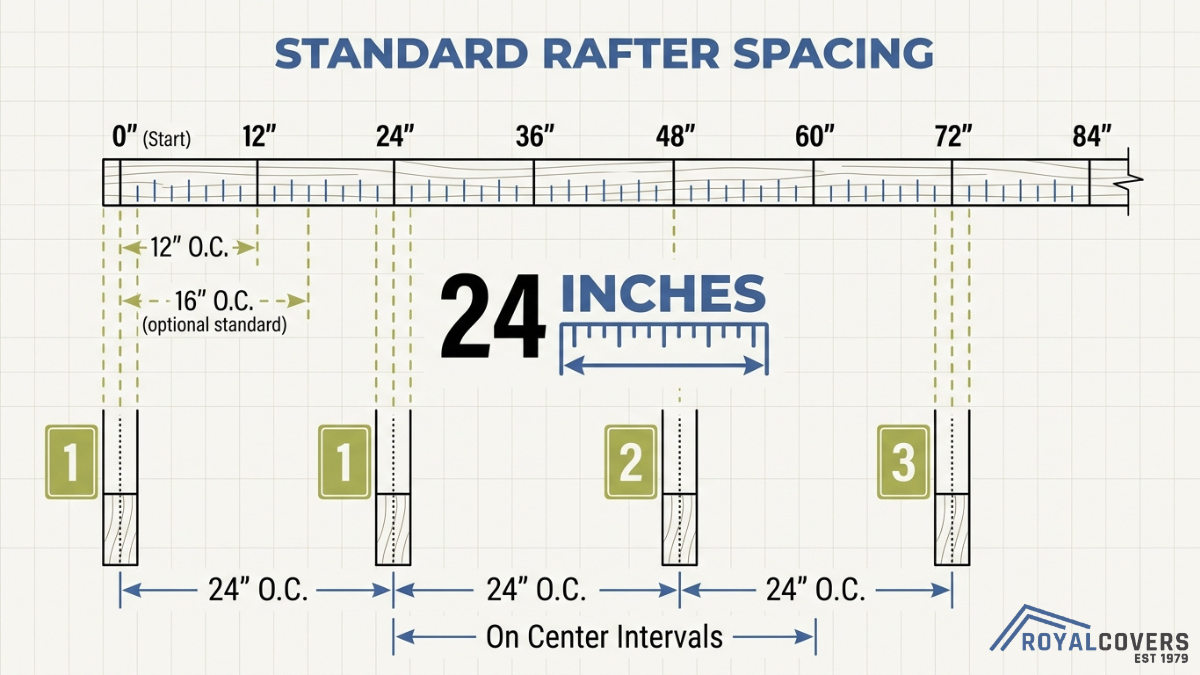
The standard spacing for Alumawood rafters is 24 inches on center. According to a Duralum Products engineering report, rafter spacing for lattice structures is typically set at 24 inches on center, with overhangs limited to a maximum of 25% of the clear span or 36 inches, whichever is less.
To mark this spacing accurately:
- Hook your tape measure at the outside edge of the first rafter position on the ledger board.
- Mark every 24 inches along the ledger’s top face, using a framing square to transfer each mark squarely across.
- Repeat identical measurements along the header beam so ledger and beam marks align perfectly.
Confirming that post placement matches these intervals before fastening any rafters prevents compounding measurement errors across the full span.
How Do You Account for Roof Panel Overhang in Measurements?
You account for roof panel overhang in measurements by extending your rafter length beyond the header beam while keeping the overhang within structural limits. Rafter overhangs must not exceed 25% of the clear span or 36 inches, whichever value is smaller.
Start by measuring the clear span between the ledger board and the front beam. Multiply that distance by 0.25 to find your maximum allowable overhang. Add this overhang dimension to the clear span for your total rafter cut length.
When laying out spacing marks, ensure the outermost rafters account for panel edge alignment. Roof panels need full rafter support at their outside edges, so the first and last rafter positions may shift slightly inward from the structure’s outer frame. With spacing confirmed, the next step is cutting each rafter to the correct length.
How Do You Cut Alumawood Rafters to the Right Length?
You cut Alumawood rafters to the right length by using the correct blade, measuring precisely, and protecting the factory finish throughout. The following subsections cover blade selection and finish preservation.
What Saw Blade Works Best for Cutting Alumawood?
The saw blade that works best for cutting Alumawood is a TCG (Triple Chip Grind) carbide-tipped blade with 80 to 100 teeth. According to Jinghang Tool, this tooth configuration ensures a smooth finish on aluminum extrusions and prevents the saw from biting into the soft metal. A standard miter saw or circular saw accepts these blades readily. Set the blade speed to a moderate RPM, as excessive speed generates heat that can melt aluminum shavings onto the cut edge. Clamping the rafter securely before cutting eliminates vibration that leads to rough edges.
How Do You Avoid Cracking or Chipping the Finish?
You avoid cracking or chipping the finish by protecting the rafter surface before, during, and after cutting. Key precautions include:
- Place protective tarps or soft padding beneath all aluminum components to prevent scratches from rough surfaces.
- Apply painter’s tape along the cut line on both sides of the rafter to shield the powder-coated finish from blade contact.
- Support the full length of the rafter so the cutoff piece does not drop and dent the painted surface.
- Deburr cut edges with a fine file, stroking away from the finish to avoid peeling.
Alumawood’s factory paint finish is susceptible to damage from rough handling, so every contact point during cutting deserves deliberate protection.
With rafters cut cleanly, the next step is attaching them securely to the ledger board.
How Do You Attach Alumawood Rafters to the Ledger Board?
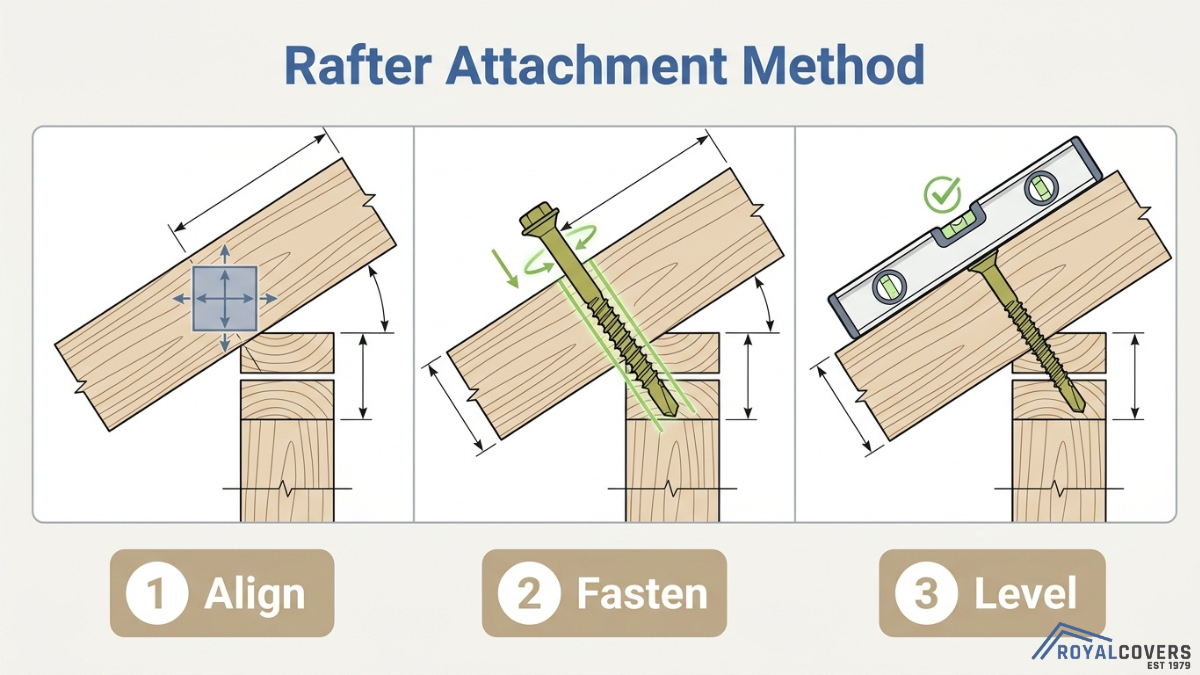
You attach Alumawood rafters to the ledger board by aligning each rafter to your pre-marked spacing, securing with self-drilling screws, and verifying flush, level contact. The following steps cover alignment, fastener selection, and leveling.
How Do You Align the First Rafter to the Ledger Board?
You align the first rafter to the ledger board by positioning it at your outermost layout mark, typically flush with the ledger’s end. Hold the rafter tab firmly against the ledger face while a helper checks that the rafter runs perpendicular using a framing square. Once square, clamp the rafter in place before driving any fasteners. This initial rafter establishes the reference line for all subsequent rafters, so precision here prevents cumulative spacing errors across the entire structure.
What Fasteners Secure Rafters to the Ledger Board?
The fasteners that secure rafters to the ledger board are #14 x 3/4-inch self-drilling screws designed for aluminum-to-aluminum connections. According to Amerimax Exterior Home Products, structural hardware for Alumawood systems includes 1/4″x5″ lag screws for ledger attachment and #14×3/4″ self-drilling screws for post-to-header connections. Self-drilling screws eliminate the need for pre-drilled pilot holes in the aluminum extrusion, reducing installation time while creating a tight mechanical bond. Drive screws through the rafter’s pre-punched mounting holes into the ledger channel until snug; avoid over-tightening, which can strip the aluminum threads.
How Do You Ensure Each Rafter Sits Flush and Level?
You ensure each rafter sits flush and level by checking two contact points before final fastening. Press the rafter tab flat against the ledger face with no gaps, confirming full surface contact. Then place a level across the rafter’s top edge to verify it matches your planned slope. For solid Alumawood covers, the required minimum slope is 1/4-inch per foot to allow proper water runoff. If a rafter rocks or gaps appear, shim behind the ledger or adjust the mounting hole position before driving screws.
With rafters secured at the house side, the next step connects them to the front header beam.
How Do You Secure Alumawood Rafters to the Header Beam?
You secure Alumawood rafters to the header beam using fasteners with sealing washers, proper slope alignment, and weatherproof caulking at every penetration point. The subsections below cover setting the correct slope and the connection method for the front beam.
How Do You Set the Correct Slope for Water Runoff?
You set the correct slope for water runoff by maintaining a minimum pitch of 1/4-inch per foot (0.25″/ft) from the ledger board down to the front header beam. According to Amerimax Exterior Home Products, this 0.25″/ft minimum slope is required for solid patio covers to ensure adequate water drainage and prevent pooling.
Before fastening each rafter, verify the slope with a level and tape measure. For a 10-foot projection, the front beam should sit approximately 2.5 inches lower than the ledger attachment point. Consistent slope across all rafters prevents low spots where standing water can accumulate and stress the aluminum extrusions over time.
What Connection Method Joins Rafters to the Front Beam?
The connection method that joins rafters to the front beam uses self-drilling screws driven through pre-punched holes in the rafter tail and into the header channel. Each fastener must be fitted with a sealing washer to prevent moisture intrusion at the penetration point.
After seating each rafter into the beam’s receiving channel, apply caulk generously along the joint where the rafter meets the header. This two-layer approach, mechanical fastener plus sealant, creates a weathertight connection that resists both uplift forces and water infiltration. Skipping the sealing washer or caulk is one of the most common mistakes that leads to premature corrosion at beam connections.
With the header beam connections secured, installing rafter support brackets and clips reinforces the structure at mid-span.
How Do You Install Rafter Support Brackets and Clips?
You install rafter support brackets and clips by positioning them at manufacturer-specified intervals along the rafter span and fastening with self-drilling screws to the correct torque. The following covers placement and fastening technique.
Where Should Mid-Span Support Brackets Be Placed?
Mid-span support brackets should be placed at the center point of the rafter’s unsupported length between the ledger board and the header beam. For spans exceeding 10 feet, position brackets evenly to divide the span into equal segments. Align each bracket directly beneath the rafter’s bottom flange, ensuring it contacts the support structure below. Proper mid-span placement prevents rafter deflection under live loads of 10 to 20 psf, which aluminum patio covers are engineered to handle according to Amerimax Exterior Home Products specifications. Always verify bracket locations match your engineering plan before drilling pilot holes.
How Tight Should You Fasten Rafter Clips Without Warping?
You should fasten rafter clips snug against the aluminum surface without compressing or deforming the extrusion profile. Use a variable-speed drill set to low torque, stopping as soon as the clip seats firmly. Over-tightening crushes the hollow aluminum channels, creating stress points that compromise structural integrity over time. A good rule: tighten until the clip eliminates play between the rafter and beam, then stop. If you notice the aluminum dimpling or the clip bowing, back the fastener out slightly. For installers accustomed to wood framing, aluminum requires a lighter touch since the material lacks the compression tolerance of solid lumber.
With brackets and clips secured, you can begin attaching roof panels across the rafters.
How Do You Attach Roof Panels to the Installed Rafters?
You attach roof panels to installed rafters by running them perpendicular to the rafter direction and securing them with self-drilling screws equipped with sealing washers. The subsections below cover panel orientation and joint sealing.
Which Direction Should Roof Panels Run Across Rafters?
Roof panels should run perpendicular to the rafters, spanning from one side of the structure to the other. This orientation allows each panel to bear on multiple rafters simultaneously, distributing weight evenly across the frame. Panels slide into interlocking channels along their edges, creating a continuous surface. Starting installation from the lowest edge of the slope ensures proper overlap for water drainage. Each panel is fastened at every rafter crossing point using #14 self-drilling screws with sealing washers to prevent moisture intrusion at penetration points.
For most residential Alumawood covers, this perpendicular layout also simplifies alignment since the rafter spacing provides consistent, pre-measured attachment points across the entire roof surface.
How Do You Seal Panel Joints to Prevent Leaks?
You seal panel joints to prevent leaks by combining mechanical interlocks with sealant at every connection point. According to Alumawood Factory Direct’s installation specifications, all fasteners penetrating the header beam must be equipped with sealing washers, and caulk must be applied generously along the house attachment and inside gutter splices for weatherproofing.
Key sealing steps include:
- Applying a continuous bead of exterior-grade silicone caulk along the ledger board connection where panels meet the house wall.
- Using sealing washers on every screw that penetrates the panel surface to compress a watertight gasket around the fastener hole.
- Caulking inside gutter splices where two gutter sections join to prevent water from dripping through seams.
- Overlapping panel interlocks in the direction of water flow so gravity pulls moisture away from joints rather than into them.
Proper slope plays a critical supporting role here; a minimum pitch of 1/4-inch per foot ensures water moves toward the gutters rather than pooling at sealed joints.
With panels secured and sealed, addressing common installation mistakes helps protect the finished structure long-term.
What Common Alumawood Rafter Installation Mistakes Should You Avoid?
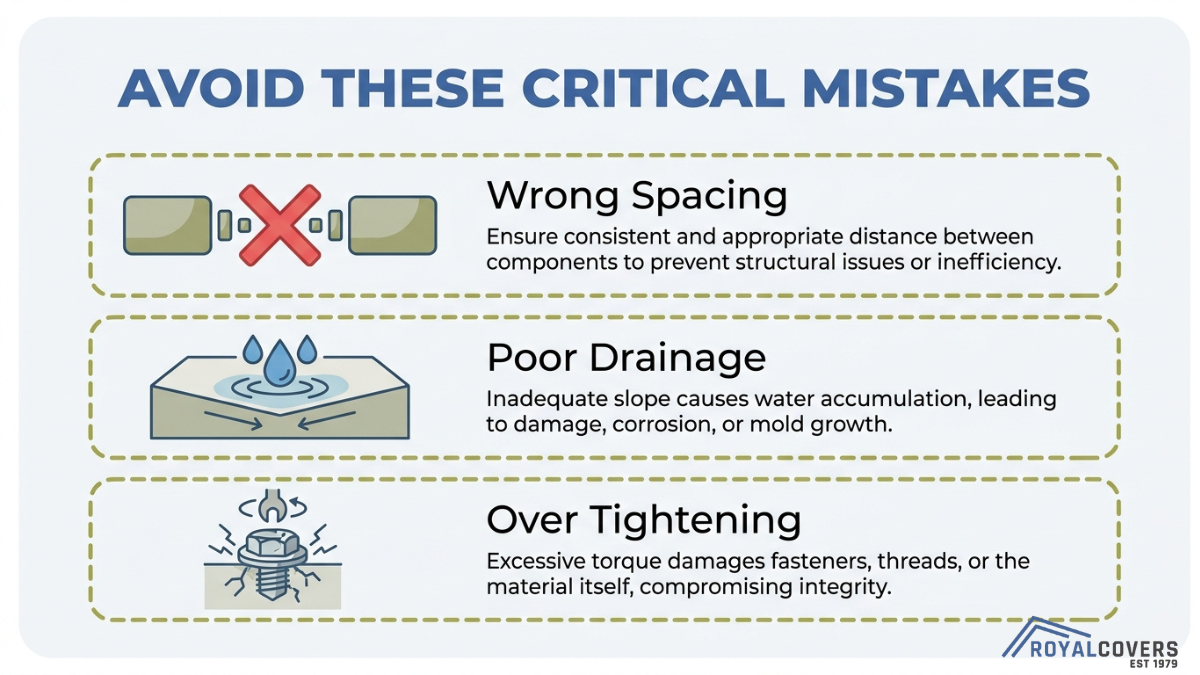
The most common Alumawood rafter installation mistakes involve incorrect spacing, inadequate slope, and over-tightened fasteners. Each error compromises structural integrity or causes premature damage.
What Happens If Rafters Are Spaced Too Far Apart?
Rafters spaced too far apart cause panel sagging, reduced load capacity, and potential structural failure under wind or rain loads. According to Duralum Products, Inc., rafter spacing for lattice structures is typically set at 24 inches on-center, while rafter overhangs are limited to a maximum of 25% of the clear span or 36 inches, whichever is less.
Exceeding these specifications forces roof panels to bear loads they were never designed to handle alone. Over time, the unsupported spans flex and weaken, particularly under accumulated debris or standing water. Sticking to manufacturer-specified spacing is one of the simplest ways to protect the structure’s long-term performance.
How Does Improper Slope Cause Water Pooling Issues?
Improper slope causes water pooling by preventing adequate drainage across solid roof panels. According to Amerimax Exterior Home Products, a minimum slope of 1/4-inch per foot is required for solid patio covers to ensure adequate water runoff and prevent pooling.
When this minimum pitch is not achieved, water collects in low spots along the panels. Standing water adds unexpected weight, accelerates finish degradation, and can eventually cause corrosion at fastener penetration points. Even a slight miscalculation during header or ledger placement can eliminate the necessary grade across the entire span. For most installations, verifying slope with a level at both ends before securing rafters permanently prevents this costly mistake.
Why Does Over-Tightening Fasteners Damage Alumawood?
Over-tightening fasteners damage Alumawood because aluminum extrusions are softer than steel hardware, making them susceptible to cracking, warping, and thread stripping under excessive torque. According to Try-Tech Industries, concrete anchor bolts for post brackets must be tightened to exactly 7 foot-pounds with a torque wrench, or 2 to 3 turns from a finger-tight position.
Applying force beyond these specifications crushes the aluminum profile around the fastener hole, creating stress fractures that spread over time. Damaged connection points then lose clamping strength and allow movement under wind loads. A calibrated torque wrench removes guesswork from this process entirely.
Avoiding these common errors ensures rafters maintain their engineered load ratings throughout the structure’s lifespan.
How Do You Maintain Alumawood Rafters After Installation?
You maintain Alumawood rafters after installation by washing them occasionally with clear water and a soft-bristled brush. Aluminum’s resistance to rot, warping, and pest damage means these rafters require far less upkeep than wood alternatives.
According to Alumawood Factory Direct, average rainfall is typically sufficient to maintain the appearance of the factory finish, making additional cleaning necessary only when debris or dust accumulates. For most homeowners, a seasonal rinse with a garden hose removes anything rain missed.
This minimal maintenance demand is one reason properly installed aluminum patio covers achieve a projected lifespan of 30+ years. Avoiding harsh chemical cleaners and abrasive pads preserves the embossed wood-grain texture. With routine care handled, deciding between DIY and professional installation becomes the final consideration.
Should You Hire a Professional for Alumawood Rafter Installation?
You should hire a professional when the project exceeds your structural knowledge, tool availability, or local permit requirements. The following sections cover what Royal Covers offers and the key installation takeaways.
Can Royal Covers Handle Your Custom Alumawood Patio Cover?
Yes, Royal Covers can handle your custom Alumawood patio cover. With over 45 years of professional installation experience in Phoenix, Royal Covers specializes in designing and building Alumawood shade structures engineered for Arizona’s desert climate.
Professional installation matters because Alumawood systems demand precision. According to Valley Patios (2025), properly installed aluminum patio covers have a projected lifespan of 30+ years due to the material’s inherent resistance to rot, warping, and pest damage. Achieving that longevity requires correct structural engineering, including load ratings of 10 to 20 psf and wind resistance up to 130 mph.
Royal Covers handles every complexity, including:
- Custom designs using insulated panel systems and lattice configurations
- Building permit acquisition and HOA approvals
- Structural compliance with California codes requiring permits for covers exceeding 120 square feet
- Full-time, trained installation crews managed by a dedicated installation manager
For homeowners who want guaranteed structural integrity without sourcing specialized tools or navigating code requirements, Royal Covers eliminates that burden entirely.
What Are the Key Takeaways About Installing Alumawood Rafters?
The key takeaways about installing Alumawood rafters center on precision, proper materials, and structural compliance. Whether you tackle the project yourself or hire a professional, these principles determine long-term performance:
- Rafter spacing must follow manufacturer specifications, typically 24 inches on-center for lattice structures.
- A minimum slope of 1/4-inch per foot prevents water pooling on solid covers.
- All fasteners penetrating beams require sealing washers and caulk for weatherproofing.
- Protective tarps must cover work surfaces to prevent finish damage during installation.
- Building permits are required in most jurisdictions for covers exceeding 120 square feet.
DIY installation costs range from $12.77 to $18.04 per square foot, making it budget-friendly when done correctly. However, installation quality matters more than material selection for preventing long-term failures. If structural confidence or permit navigation feels uncertain, professional installation from Royal Covers protects both your investment and your home’s safety.