
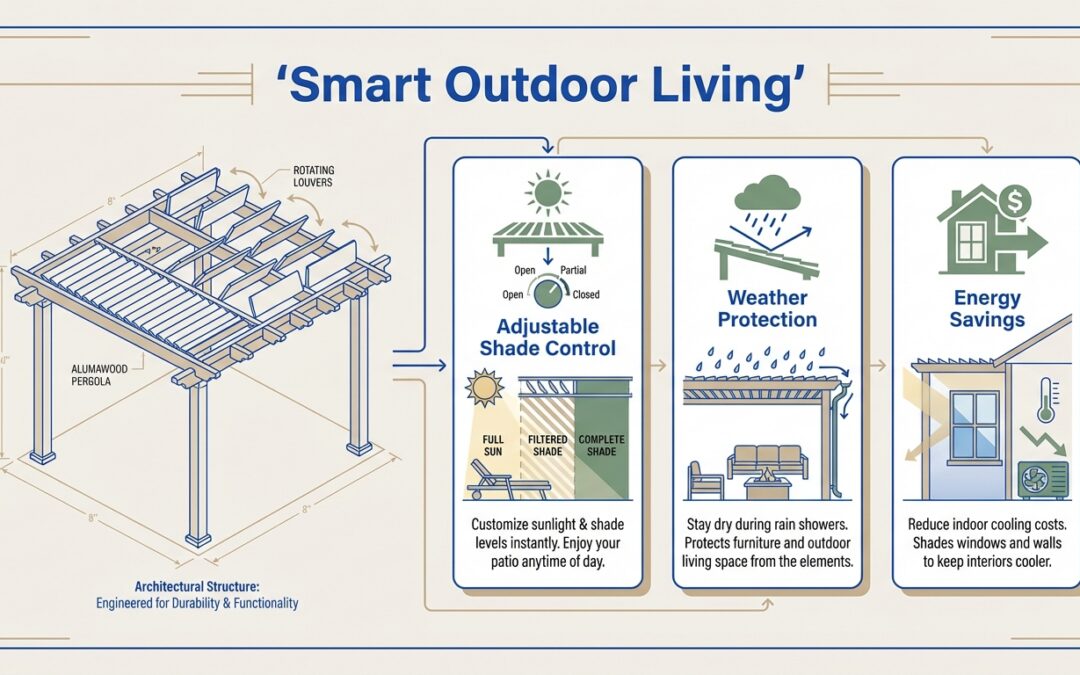
A louvered Alumawood pergola is an adjustable outdoor roof system that uses rotating aluminum blades to control sunlight, shade, and airflow on demand. Alumawood itself is aluminum processed to resemble real wood, combining natural aesthetics with corrosion-resistant, low-maintenance performance.
This guide covers the core components and materials of the system, manual and motorized operation methods, shade and ventilation optimization, ongoing maintenance practices, troubleshooting common issues, and long-term value preservation.
The louvered system relies on rotating roof blades, a durable aluminum frame, and either a hand crank or electric motor to pivot those blades between open and closed positions. Understanding how these components connect is the first step to confident daily use.
Manual operation involves turning a hand crank to rotate the louvers, while motorized systems use an electric motor controlled by a remote, wall switch, or smartphone app. Automated options add sun, wind, and rain sensors that adjust blade angles without any input from you, and modern motors operate at over 90% efficiency for minimal energy draw.
Strategic louver positioning throughout the day can reduce surface temperatures by 10 to 15°C in arid climates and cut solar heat gain on nearby windows by up to 65 to 77%. Angling the blades to match the sun’s path keeps your outdoor space comfortable while lowering cooling costs indoors.
Desert dust, soluble salts, and intense UV exposure demand consistent upkeep. Regular cleaning with mild soap, periodic lubrication of moving parts, and routine inspections prevent corrosion and mechanical wear that shorten the system’s lifespan.
When louvers stick, squeak, or stop responding to controls, targeted troubleshooting (checking obstructions, battery power, and mechanical alignment) resolves most problems before a professional service call is needed.
What Are the Main Components of a Louvered Alumawood Pergola?
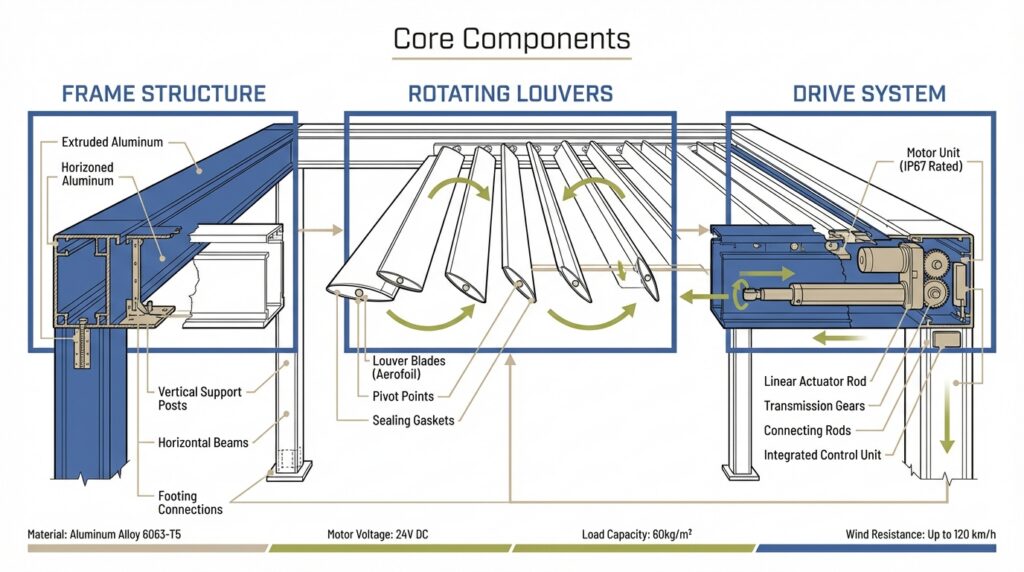
The main components of a louvered Alumawood pergola are adjustable roof blades, aluminum structural framing, and a support system engineered for durability. Each component plays a specific role in shade control, weather resistance, and long-term performance.
How Do Louvered Roof Blades Function?
Louvered roof blades function by rotating on a central axis to control sunlight, airflow, and rain exposure. Each blade pivots between fully open and fully closed positions, allowing precise shade adjustment throughout the day. When closed, the blades interlock to form a watertight seal that sheds rain. When fully open, they permit maximum ventilation and natural light. A mechanical linkage connects all blades so they rotate in unison, whether operated by hand crank, motorized remote, or automated sensor system. This synchronized rotation is what makes louvered pergolas adaptable to rapidly changing weather conditions.
What Materials Are Used in Alumawood Pergolas?
The materials used in Alumawood pergolas are primarily aluminum alloys processed to replicate the appearance of natural wood. Aluminum naturally forms a protective oxide layer that provides excellent corrosion resistance, making it well suited for outdoor structures. The finish typically includes a baked-on powder coating that resists UV fading and peeling.
However, desert conditions introduce unique challenges. A study published in the Wiley Online Library on atmospheric corrosion of aluminum in a desert environment found that high levels of soluble salts and high pH in desert soil can cause serious atmospheric corrosion, with magnesium chloride identified as the most corrosive salt tested. This makes proper finishing and regular cleaning especially important for long-term material integrity.
How Is the Pergola Structured for Durability?
The pergola is structured for durability through a combination of reinforced posts, load-bearing beams, and engineered connections designed to resist extreme weather. Standard residential pergolas should withstand wind speeds of at least 60 MPH, while heavy-duty, steel-reinforced structures can achieve ratings of 70 MPH or higher. These ratings are critical during Phoenix’s monsoon season, when sudden wind gusts can stress outdoor structures significantly.
The ISO 13823 standard provides general principles for verifying a structure’s durability across its full design service life. Properly engineered footings, corrosion-resistant fasteners, and reinforced aluminum framing all contribute to a pergola that maintains structural performance for years. Understanding these components sets the foundation for learning how to operate and adjust the louvered system effectively.
How Do You Manually Operate the Louvered System?
You manually operate the louvered system by using the hand crank mechanism installed on your pergola. The steps below cover proper technique, while the second section addresses mistakes that can cause damage.
What Steps Should You Follow to Open and Close the Louvers?
The steps to open and close the louvers on a manual system are straightforward:
- Locate the hand crank, typically mounted on one of the pergola’s support posts.
- Turn the crank clockwise slowly to open the louver blades to your desired angle.
- Stop cranking once the louvers reach the position you want, whether fully open, partially tilted, or fully closed.
- Reverse the crank direction (counterclockwise) to close the louvers back to a sealed position.
Always apply steady, even pressure rather than forcing the mechanism. Manual systems are the most basic and cost-effective option; they are reliable but require consistent technique to avoid wear on internal components. For homeowners who prefer hands-free control, motorized systems use an electric motor controlled by a remote, with modern induction motors achieving efficiencies of 90–93% according to U.S. Department of Energy conservation standards.
What Are Common Manual Operation Mistakes to Avoid?
Common manual operation mistakes to avoid include:
- Forcing the crank past resistance. If the handle stops turning smoothly, debris or a misaligned louver blade is likely the cause. Forcing it risks bending internal linkage rods.
- Cranking too fast. Rapid turning stresses the gear mechanism and can strip teeth over time.
- Neglecting to close louvers before storms. Leaving blades open during high winds exposes the pivot points to unnecessary load.
- Ignoring unusual sounds. Grinding or clicking during operation signals that lubrication or an adjustment is needed before minor issues become costly repairs.
Most of these problems are preventable with gentle, deliberate use. With the manual basics covered, understanding how motorized controls compare helps you decide which operation method best fits your lifestyle.
How Does Motorized Operation Differ From Manual Controls?
Motorized operation differs from manual controls by replacing hand-crank effort with electric motors that adjust louvers at the press of a button. The sections below cover available motorized control types, remote and wall switch usage, and malfunction troubleshooting.
What Types of Motorized Controls Are Available?
The types of motorized controls available for louvered Alumawood pergolas include:
- Remote-controlled systems that use a handheld transmitter to open, close, or angle louvers from anywhere in the outdoor space.
- Wall-mounted switches that provide a fixed control point, typically installed near the door leading to the patio.
- Automated sensor-driven systems that integrate sun, wind, and rain sensors to adjust louvers without any manual input.
Each option uses an electric motor to drive the louver mechanism. For homeowners who want both convenience and efficiency, motorized controls eliminate the physical effort required by a hand crank while delivering precise louver positioning.
How Do You Use a Remote or Wall Switch With Your Pergola?
You use a remote or wall switch with your pergola by pressing directional buttons that signal the motor to rotate louvers open, closed, or to a partial angle. Most remotes offer three core functions:
- Press the “open” button to fully retract louvers for maximum sunlight.
- Press the “close” button to seal louvers for full shade or rain protection.
- Use intermediate settings to angle louvers at partial positions for filtered light.
Wall switches operate identically but remain in a fixed location. According to the U.S. Department of Energy, window awnings can reduce solar heat gain by up to 65% on south-facing windows and 77% on west-facing exposures, a comparable benefit that strategically angled pergola louvers provide.
What Should You Do If the Motorized System Malfunctions?
You should first check the power supply, remote batteries, and any visible obstructions blocking louver movement. If these basic checks do not resolve the issue, most motorized louvered pergolas include a manual override. Manual systems operated by a hand crank serve as a reliable backup, ensuring you can still adjust louvers during an electrical failure.
Regular inspection helps prevent malfunctions before they occur. The moving parts of a louvered system, particularly in motorized configurations, should be checked periodically for wear and lubricated to ensure smooth operation. If the motor itself fails to respond after troubleshooting, contact a qualified technician rather than attempting internal repairs.
With motorized controls understood, optimizing your louver positions throughout the day maximizes both shade and airflow.
How Can You Optimize Shade and Ventilation With the Louvers?
You can optimize shade and ventilation with the louvers by adjusting blade angles throughout the day, selecting settings suited to Phoenix heat, and understanding how these adjustments improve thermal comfort.
How Should You Adjust Louvers Throughout the Day?
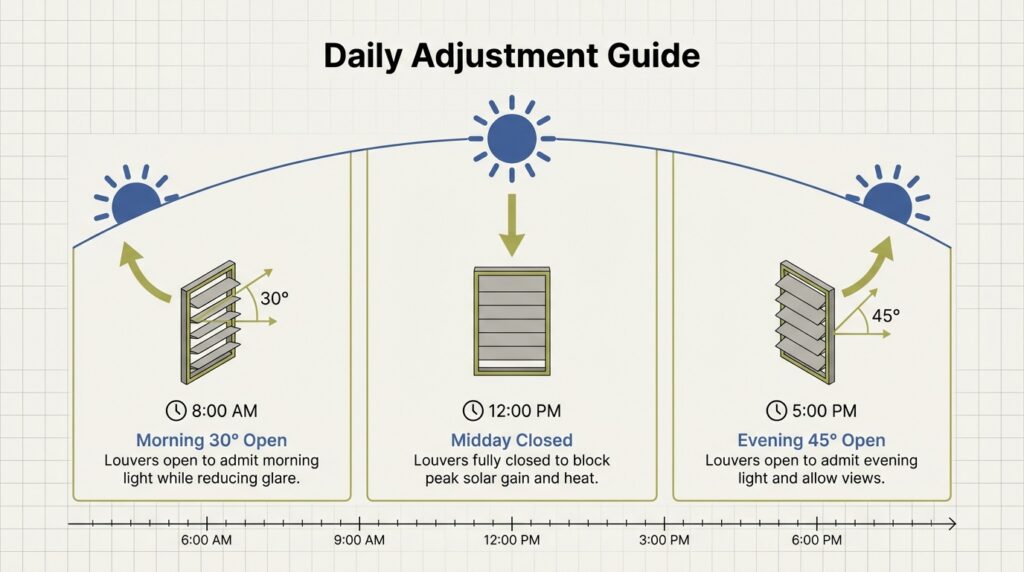
You should adjust louvers throughout the day by tracking the sun’s position and changing blade angles accordingly. In the morning, partially open louvers allow filtered light while blocking low-angle glare. During midday, closing louvers to near-flat provides maximum shade when UV exposure peaks. Late afternoon calls for a slight reopening to capture cooling breezes as temperatures drop.
Royal Covers’ Equinox Louvered Roof systems can be configured with both motorized and automated sensor options, designed specifically for Phoenix’s desert climate with over 45 years of local installation experience. For homeowners who prefer manual or remote-controlled setups, setting three to four daily adjustment points creates a reliable routine that balances shade coverage with airflow.
What Settings Work Best in Phoenix’s Extreme Sun?
The settings that work best in Phoenix’s extreme sun prioritize maximum closure during peak heat hours. Between 10 a.m. and 4 p.m., fully closed or near-closed louvers block the most intense solar radiation. Angling blades at roughly 10 to 15 degrees from flat still deflects direct sun while permitting hot air to escape upward through narrow gaps.
On days exceeding 110°F, keeping louvers completely sealed creates a solid shade canopy that mimics the protection of a full roof panel. For evenings when temperatures remain elevated, opening louvers to 45 degrees or more encourages cross-ventilation, helping the covered space cool faster. Pairing these louver positions with exterior roll down shades on sun-facing sides further reduces radiant heat beneath the pergola.
How Does Adjusting Louvers Improve Outdoor Comfort?
Adjusting louvers improves outdoor comfort by controlling how much solar energy reaches the space below. A study published on ScienceDirect on outdoor thermal comfort in a humid subtropical region found that artificial shading in arid environments can reduce surface temperatures by 10 to 15°C. Louvered pergolas deliver this benefit with added flexibility, since blade angles can shift from full shade to open sky in seconds.
Beyond temperature, airflow plays an equally important role. When louvers tilt open, convective currents carry trapped heat upward and draw cooler surrounding air into the covered area. This dual control of radiation and ventilation transforms a patio from an unusable hot zone into a comfortable outdoor living space, even during Arizona’s longest stretches of triple-digit heat.
With shade and ventilation dialed in, consistent maintenance keeps these systems performing at their best.
What Maintenance Is Required for Smooth Operation?
Maintenance for smooth operation includes regular cleaning, periodic lubrication, and proactive protection against desert dust. The following subsections cover inspection schedules, adjustment needs, and debris prevention strategies.
How Frequently Should You Clean and Inspect the System?
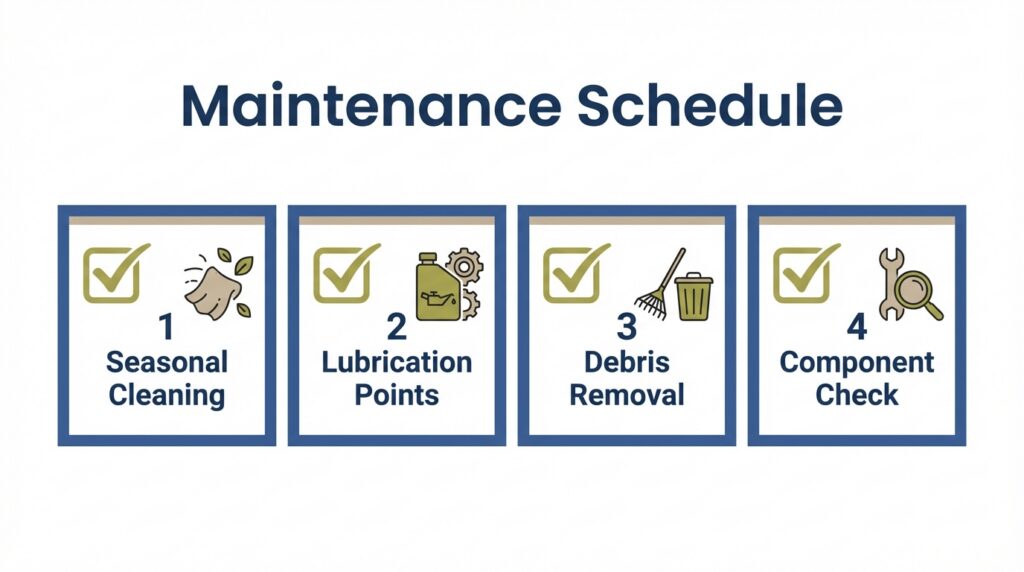
You should clean and inspect the system at least once per season, with additional cleanings after dust storms or monsoon events. Regular cleaning removes dust, debris, and salt deposits that can accelerate corrosion on aluminum surfaces.
A recommended cleaning and inspection routine includes:
- Washing all Alumawood panels and louver blades with mild soap and water.
- Rinsing thoroughly to prevent soap residue buildup.
- Checking louver pivot points and tracks for accumulated grit.
- Inspecting motorized components for visible wear or loose connections.
Abrasive cleaners should be avoided, as they can damage the protective finish. Royal Covers backs all installations with a 2-year workmanship warranty and provides ongoing customer support to help homeowners maintain their louvered systems for optimal long-term performance.
What Lubrication or Adjustments Are Needed Over Time?
The lubrication and adjustments needed over time focus on the moving parts of the louvered system. Pivot points, hinge mechanisms, and track channels require periodic application of a silicone-based lubricant to prevent friction and sticking.
Key maintenance tasks include:
- Applying silicone spray to louver pivot points every three to six months.
- Checking track alignment to ensure louvers open and close without resistance.
- Tightening any fasteners loosened by thermal expansion cycles.
- Testing motorized controls for response lag or unusual noise.
Petroleum-based lubricants attract dust and should be avoided in desert environments. A consistent lubrication schedule prevents the kind of mechanical drag that leads to premature motor strain or manual crank difficulty.
How Can You Protect the Pergola From Desert Dust and Debris?
You can protect the pergola from desert dust and debris through a combination of routine care and environmental awareness. Alumawood forms a natural protective oxide layer that provides excellent corrosion resistance, yet Phoenix’s desert conditions, including airborne dust and soluble salts, can challenge that protection over time.
Effective protection measures include:
- Hosing down the structure after haboobs or heavy wind events.
- Keeping nearby landscaping trimmed to reduce organic debris accumulation.
- Closing louvers during dust storms to minimize interior buildup on mechanical components.
- Inspecting the finish annually for signs of pitting or discoloration.
Proactive debris management is often the most overlooked step, but it directly extends the service life of both the finish and the mechanical system. With these protective habits established, troubleshooting any operational issues becomes far simpler.
How Do You Troubleshoot Common Operational Problems?
You troubleshoot common operational problems by systematically checking mechanical alignment, lubrication, and electrical connections. The following subsections cover louver movement failures, minor annoyances like squeaks and sticking, and when professional help is warranted.
Why Won’t the Louvers Open or Close Properly?
The louvers won’t open or close properly when debris, misalignment, or a mechanical obstruction interferes with the drive system. Desert dust and small debris frequently accumulate in louver tracks and pivot points, preventing smooth rotation.
Common causes include:
- Accumulated dirt or gravel lodged in the pivot brackets.
- A disconnected or stripped linkage arm between the motor and louver blades.
- A tripped circuit breaker or blown fuse cutting power to the motorized system.
- Bent or warped louver blades binding against the frame.
Start by clearing visible debris from the track and pivot areas. For motorized systems, verify that the power source is active and the motor engages when triggered. If the louvers move partway and stop, a linkage component may be damaged or the motor may be straining against an obstruction. Forcing the system risks further damage, so stop operation immediately if resistance is felt.
How Do You Address Squeaks, Sticking, or Remote Issues?
You address squeaks, sticking, or remote issues by identifying whether the problem is mechanical friction, buildup, or an electrical signal failure. Each symptom points to a different root cause.
- Squeaks typically result from dry pivot points or metal-on-metal contact where lubrication has worn away. Applying a silicone-based lubricant to hinges and pivot brackets usually eliminates the noise.
- Sticking often indicates dust and salt deposit accumulation on moving surfaces. Cleaning with mild soap and water, then reapplying lubricant, restores smooth travel.
- Remote malfunctions may stem from dead batteries, signal interference, or a receiver that needs resynchronization.
For remote issues, replace the batteries first. If the remote still fails, consult your system’s manual for the re-pairing procedure. Most receivers have a reset button near the motor housing. In my experience, roughly half of all “broken remote” calls resolve with a simple battery swap.
When Should You Call a Professional for Repairs?
You should call a professional for repairs when the issue involves internal motor failure, structural damage, or electrical faults beyond basic troubleshooting. Licensed contractors in Arizona must adhere to minimum workmanship standards covering performance of construction items for the first two years of ownership.
Situations that require professional service include:
- The motor hums but louvers do not move, indicating a gear or drive failure.
- Visible cracks, bends, or corrosion damage on structural frame components.
- Wiring issues such as exposed cables, burning smells, or repeated breaker trips.
- Warranty-covered defects within the manufacturer’s or installer’s coverage period.
Attempting internal motor or electrical repairs without proper training can void warranties and create safety hazards. A qualified technician can diagnose whether a component needs replacement or recalibration far more efficiently. With troubleshooting basics handled, consistent operation and care directly influence how long your pergola performs at its best.
How Does Proper Operation Extend the Lifespan and Value of Your Pergola?
Proper operation extends the lifespan and value of your pergola by reducing mechanical stress, preventing corrosion, and preserving structural integrity over time. The following subsections cover the long-term benefits of consistent maintenance and how regular use prevents premature wear.
What Are the Long-Term Benefits of Maintaining Your Alumawood Pergola?
The long-term benefits of maintaining your Alumawood pergola include sustained corrosion resistance, reliable mechanical performance, and preserved property value. Aluminum naturally forms a protective oxide layer, but desert dust and soluble salts can compromise that barrier over time. Consistent cleaning and inspection keep this protection intact.
Key long-term benefits include:
- Louvers and motors continue operating smoothly without seizing or binding.
- The wood-grain finish resists fading and surface degradation from UV exposure.
- Structural connections remain tight, maintaining wind resistance ratings.
- Property value increases because the pergola retains its original appearance and function.
Industry workmanship standards typically cover construction performance for the first two years of ownership, making early maintenance habits especially critical for preserving warranty coverage
How Does Regular Use Prevent Premature Wear and Tear?
Regular use prevents premature wear and tear by keeping mechanical components active and lubricated rather than allowing them to seize from prolonged inactivity. Moving parts in motorized louvered systems, including gears, linkages, and actuators, accumulate dust and debris when left stationary in desert conditions. Periodic operation circulates internal lubrication and prevents mineral buildup from bonding components together.
Structures left idle for extended periods are more vulnerable to corrosion because stagnant joints trap moisture and salt deposits. Routine cycling of the louvers distributes mechanical stress evenly, reducing concentrated wear on individual pivot points. This proactive approach costs far less than replacing seized motors or corroded hardware.
With a well-maintained pergola performing at its best, professional support ensures it stays that way for decades.
How Can Royal Covers Help With Louvered Roof Systems and Outdoor Living Upgrades?
Royal Covers can help with louvered roof systems and outdoor living upgrades by providing custom-designed Equinox Louvered Roofs, expert installation, and ongoing support built on over 45 years of Phoenix experience.

What Custom Louvered Roof Solutions Does Royal Covers Offer for Homeowners?
Royal Covers offers homeowners the Equinox Louvered Roof system, a premier adjustable structure with louvers that can be motorized or manually operated to control sun, shade, and rain protection. Each installation begins with a free on-site design consultation, where the structure is tailored to the homeowner’s space, aesthetic preferences, and functional goals.
Because louvered pergolas provide adjustable shade and ventilation well-suited to Phoenix’s dynamic weather, Royal Covers engineers every project specifically for desert conditions. Full-time, continuously trained installation teams handle the build, while Royal Covers manages all permit and HOA approvals for a hassle-free process. A 2-year workmanship warranty and limited lifetime manufacturer warranties back every project.
What Are the Key Takeaways About How to Operate Your Louvered Alumawood Pergola We Covered?
The key takeaways about how to operate your louvered Alumawood pergola center on three priorities: understanding your control system, optimizing louver positions for comfort, and committing to routine maintenance.
- Manual systems rely on a hand crank, while motorized and automated options offer remote, sensor-based, or smart home control.
- Adjusting louver angles throughout the day maximizes shade during peak heat and improves airflow when temperatures ease.
- Regular cleaning with mild soap, periodic lubrication of moving parts, and prompt troubleshooting prevent premature wear in Phoenix’s harsh climate.
- Proper operation reduces solar heat gain, extends the structure’s service life, and preserves long-term property value.
For homeowners ready to install or upgrade a louvered Alumawood pergola, Royal Covers brings over 45 years of desert-engineered expertise to every project.