
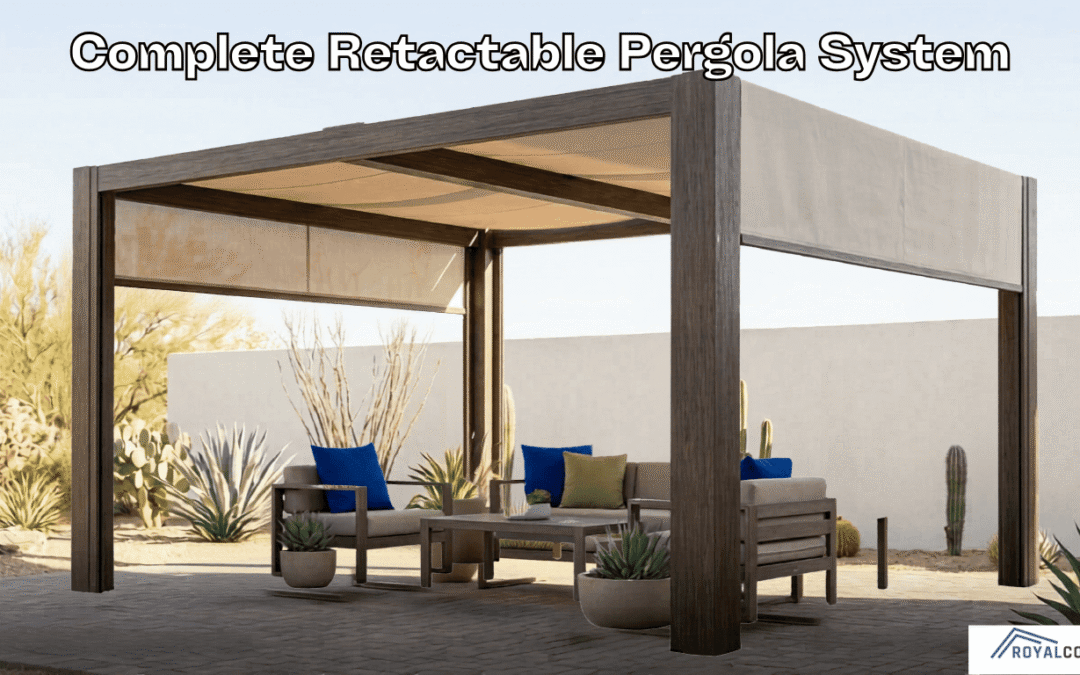
A retractable Alumawood pergola is an aluminum patio structure with an embossed woodgrain finish and a sliding canopy that opens or closes on demand. Installing one requires site preparation, code compliance, precise structural assembly, canopy integration, and ongoing maintenance.
This guide covers product fundamentals, site and permit preparation, structural framing, retractable canopy installation, common mistakes, climate considerations, and the DIY-versus-professional decision.
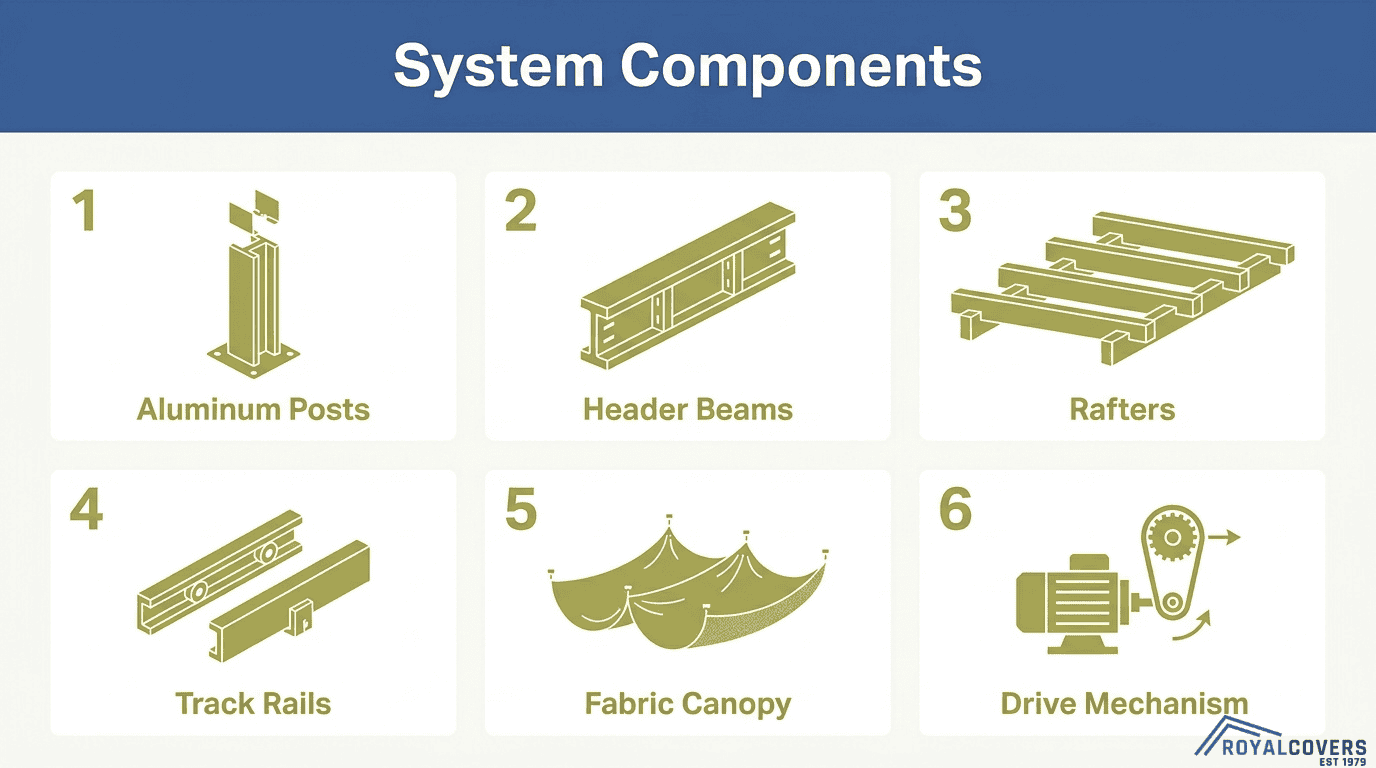
Retractable Alumawood systems use extruded aluminum posts, beams with spans up to 17 feet, and rafters typically spaced 24 inches on center. The retractable canopy slides along track rails mounted to those rafters, operated by either a manual crank or electric motor. Understanding each component simplifies the entire build.
Site preparation starts with staking an accurate footprint, contacting 811 to locate underground utilities, and confirming ground levelness. Permit requirements vary by jurisdiction, with thresholds ranging from 120 to 300 square feet depending on whether the structure is attached or freestanding.
Structural framing involves setting post footings to code-compliant depth, securing header beams, spacing rafters precisely, and verifying square with diagonal measurements. Even a quarter-inch deviation can cause the canopy to bind during retraction.
The canopy system mounts to the completed frame through parallel track rails, tensioned fabric, and either a motorized or manual drive mechanism. Proper fabric tension prevents water pooling and wind-driven wear.
Climate directly affects installation; aluminum expands in extreme heat, and high-wind regions demand deeper footings with tighter rafter spacing. Seasonal maintenance, including frame cleaning, fabric care, and hardware lubrication, protects long-term performance.
Footing engineering, electrical wiring, and permit navigation often require professional expertise, while small freestanding builds may suit experienced DIYers.
What Is a Retractable Alumawood Pergola?
A retractable Alumawood pergola is an aluminum patio structure with an embossed woodgrain finish and a sliding canopy that opens or closes on demand. The sections below explain how it differs from a fixed design and break down its main components.
How Does a Retractable Pergola Differ From a Fixed Alumawood Pergola?
A retractable pergola differs from a fixed Alumawood pergola by incorporating a movable canopy system that slides along track rails mounted to the rafters. A fixed Alumawood pergola uses either a solid roof panel or a permanent lattice to provide consistent shade that cannot be adjusted. The retractable version lets homeowners shift between full sun, filtered light, and complete coverage depending on weather or preference.
Both types share the same extruded aluminum frame with a woodgrain finish that requires minimal maintenance. According to an ICC Evaluation Service report (ESR-1398), Alumawood products are roll-formed and extruded aluminum shapes of various alloys and tempers, giving both fixed and retractable models the same structural foundation. The canopy mechanism, operated manually or by electric motor, is what sets retractable systems apart. For homeowners who want year-round flexibility rather than a single shade setting, the retractable configuration is often the more practical investment.
What Are the Main Components of a Retractable Alumawood System?
The main components of a retractable Alumawood system are the aluminum frame, the retractable canopy assembly, and the drive mechanism. Key structural and operational parts include:
- Posts and footings anchor the structure to the ground or an existing concrete slab.
- Header beams span between posts, with 3×8 beams supporting maximum spans up to 17 ft.
- Rafters run in the projection direction, typically spaced 24 inches on center, and serve as the track surface for the canopy.
- Track rails mount directly to the rafters and guide the canopy as it extends or retracts.
- Canopy fabric slides along the track rails to provide adjustable shade coverage.
- Drive mechanism operates the canopy either manually with a crank handle or through an electric motor with optional remote control.
Each component works together to create a unified system that balances structural integrity with on-demand shade control. Understanding these parts simplifies both the installation process and long-term maintenance decisions covered in later sections.
What Tools and Materials Do You Need to Install a Retractable Alumawood Pergola?
You need a combination of standard construction tools, Alumawood-specific structural components, and retractable canopy hardware to install a retractable Alumawood pergola. The essentials fall into three categories: layout and measurement tools, power and hand tools, and structural materials.
Layout and measurement tools include:
- Tape measure (25 ft minimum)
- 4-foot carpenter’s level and post level
- Speed square and framing square
- Chalk line for marking beam and rafter positions
- String line and stakes for establishing the pergola footprint
- Plumb bob for verifying post alignment
Power and hand tools include:
- Cordless drill/driver with impact-rated bits
- Hammer drill for concrete anchoring
- Circular saw with an aluminum-cutting blade
- Socket wrench set for lag bolts and carriage bolts
- Clamps for temporarily securing beams during assembly
- Step ladder and, for taller structures, an A-frame ladder rated for your working height
Structural materials and hardware include:
- Alumawood posts, beams (3×8 for spans up to 17 ft), and rafters (2×6 for spans up to 14 ft)
- Post base brackets and concrete anchors
- Self-tapping screws, lag bolts, and manufacturer-specified fasteners
- Retractable canopy system with track rails, fabric panel, and either a manual crank or motorized mechanism
- Concrete mix for footings (if setting posts into the ground)
According to an ICC Evaluation Service report (ESR-1398), Alumawood products consist of roll-formed and extruded aluminum shapes of various alloys and tempers, along with steel members formed from ASTM A653 steel. This composition means standard woodworking blades will not work; always use carbide-tipped or aluminum-rated cutting accessories.
One detail often overlooked is having enough clamps and temporary bracing on hand. Aluminum components are lighter than wood, which sounds like an advantage until a gust of wind catches an unsecured beam mid-assembly. Having at least four bar clamps and pre-cut bracing lumber saves time and prevents costly alignment errors. With your tools and materials staged, the next step is preparing the installation site.
How Do You Prepare the Installation Site for a Retractable Alumawood Pergola?
You prepare the installation site for a retractable Alumawood pergola by measuring the layout, verifying underground utility locations, and confirming ground levelness. Each step protects the structure’s long-term stability.

How Do You Measure and Mark the Layout for Your Pergola Footprint?
You measure and mark the layout for your pergola footprint by establishing reference lines from your house wall or existing structure, then staking the four corners at exact post locations. Rafter spans are measured in the projection direction while post spans are measured in the width direction, according to Alumashade technical specifications. Use a tape measure, mason’s line, and marking paint to outline the full footprint.
To confirm squareness, measure diagonally from corner to corner; both diagonals must match. Getting this right at the marking stage prevents compounding alignment errors once beams and rafters go up. Even a half-inch deviation at the footprint can translate into visible gaps in the retractable canopy track.
How Do You Check for Underground Utilities Before Digging?
You check for underground utilities before digging by contacting your local 811 service. Arizona 811 requires homeowners to call at least two full working days before excavation begins, excluding weekends and state holidays. A technician then marks buried gas, electric, water, and communication lines with color-coded paint directly on the ground.
Tristan Brown, Deputy Administrator of the Pipeline and Hazardous Materials Safety Administration, emphasized this point: “With more than $1 trillion in new infrastructure breaking ground across America, contacting 811 before digging has never been more important.” Skipping this step risks striking a utility line, which can cause costly damage, service disruptions, or serious injury. Always wait for the all-clear before breaking ground for post footings.
How Do You Ensure the Ground Is Level Before Installation?
You ensure the ground is level before installation by using a long spirit level or laser level across the entire pergola footprint. Place the level on a straight board spanning between opposite corner stakes to identify high and low spots.
For existing concrete slabs, check for cracks and drainage slopes. Minor slopes intended for water runoff are normal, but significant unevenness requires shimming post bases or grinding down high points. When installing on bare ground, compact the soil and add a gravel base to prevent future settling. Addressing grade issues before setting footings is far easier than correcting a tilted frame after the Alumawood beams and retractable track rails are already mounted.
With the site properly prepared, the next step is understanding which permits your project requires.
What Permits and Building Codes Apply to Pergola Installation?
The permits and building codes that apply to pergola installation vary by jurisdiction, structure size, attachment method, and whether electrical or plumbing is included. Key factors include square footage thresholds, setback requirements, and HOA restrictions.
Permit requirements differ significantly across cities and counties. Some jurisdictions exempt small freestanding pergolas, while others require permits for any attached shade structure regardless of size. The following breakdown covers common thresholds, code considerations, and compliance steps every homeowner should understand before breaking ground.
According to the City of Maricopa, pergolas over 200 square feet require a permit, pergolas under 200 square feet without electrical or plumbing do not need a permit, and any pergola with electrical or plumbing needs a permit regardless of size. These thresholds are representative but not universal. The City of San Diego, for example, may exempt patio covers up to 300 square feet of projected roof area for single-family and duplex residential structures. Meanwhile, the City of Elk Grove requires permits before construction begins for all attached patio covers of any size and for detached structures over 120 square feet.
Smaller structures can sometimes qualify for exemptions, though the conditions are strict. Charlotte County permits freestanding pergolas without a permit only if the structure is not attached to any building, measures no more than 12 feet by 12 feet, is constructed without footings, roofing, or sheathing, and contains no electrical or plumbing. The City of Austin similarly limits permit exemptions for one-story detached accessory structures to those with:
- No more than 200 square feet of floor area
- No more than 15 feet in height
- No plumbing connections
- No location in a flood hazard area
- No use as a dwelling
Building codes also govern structural details beyond the permit itself. Site plan submissions typically require documentation of existing structures, new structures, and setbacks, as outlined in the City of Corpus Christi’s homeowner permitting guide. For retractable Alumawood pergolas specifically, the aluminum framing components hold ICC-ES evaluation reports, which can simplify the approval process with local building departments.
One critical point homeowners frequently overlook: obtaining a building permit does not exempt compliance with HOA CC&Rs or private deed restrictions, as noted by the City of Tucson. Homeowners in planned communities should submit design plans to their HOA architectural review committee before applying for a municipal permit. Failing to do so can result in forced modifications or removal, even with a valid permit in hand.
For most homeowners, the safest approach is to contact the local building department early in the planning process. Permit thresholds, setback distances, and structural requirements shift from one municipality to the next, and assumptions based on a neighboring city’s rules can lead to costly corrections. With posts and footings set into the ground, understanding these regulations before installation begins protects both the investment and the homeowner’s legal standing.
How Do You Install the Posts and Footings for an Alumawood Pergola?
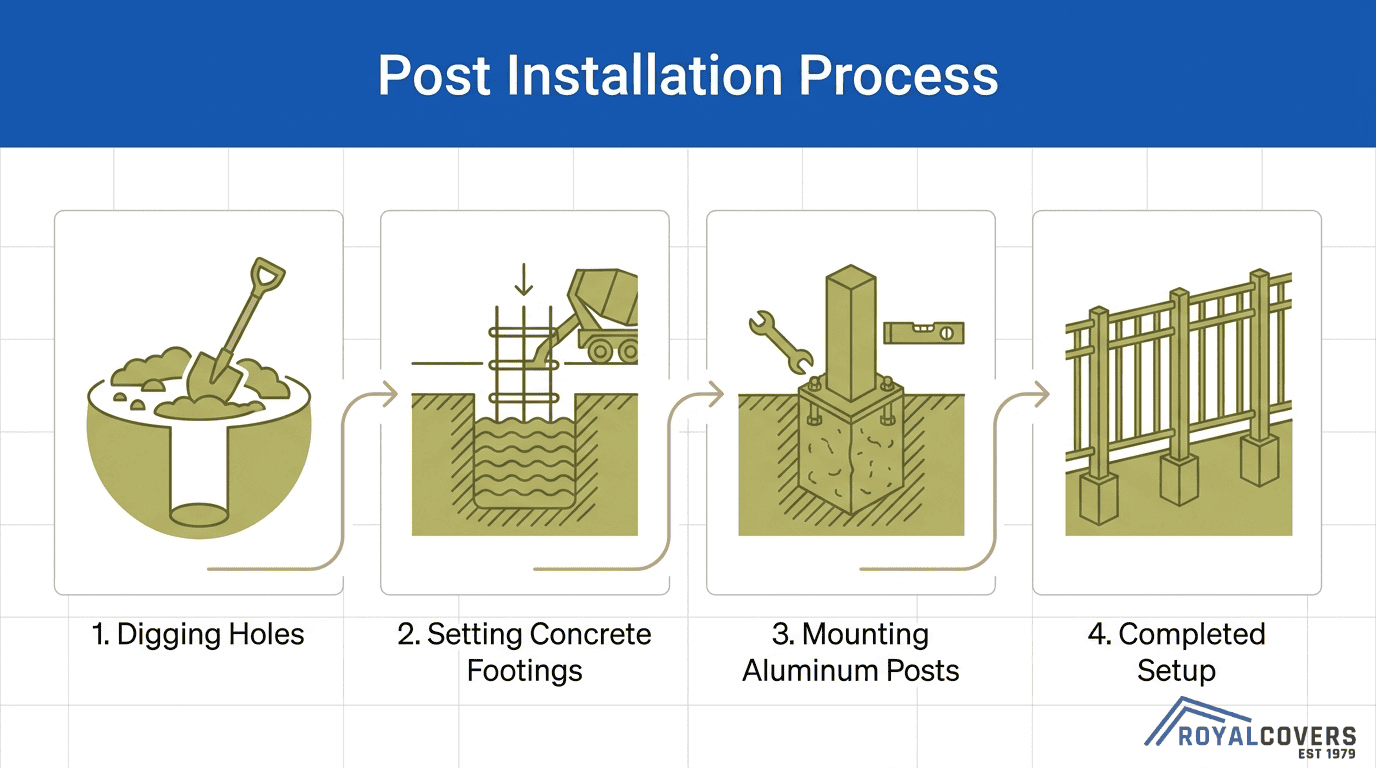
You install the posts and footings for an Alumawood pergola by digging footings to code-compliant depth, anchoring posts securely, and verifying plumb before the concrete sets. The following subsections cover footing depth, patio anchoring, ground-set footings, and bracing methods.
How Deep Should Post Footings Be for a Retractable Alumawood Pergola?
Post footings for a retractable Alumawood pergola should reach a minimum of 24 inches deep in most jurisdictions, though local building codes may require greater depth. According to the City of Spokane Valley’s residential patio cover guide, the frost line depth may require deeper footings than standard minimums indicate. In frost-free regions like Phoenix, 24 inches is typical, while colder climates often mandate 36 to 48 inches.
Footing diameter generally ranges from 10 to 12 inches for standard residential pergola posts. Soil conditions, wind load requirements, and the overall pergola span all influence the final specification. Always confirm exact requirements with your local building department before excavating, since the retractable canopy system adds operational loads that fixed covers do not.
How Do You Anchor Posts to an Existing Concrete Patio?
You anchor posts to an existing concrete patio by drilling into the slab and securing galvanized post base brackets with concrete wedge anchors or epoxy-set threaded rods. The concrete must be at least 3.5 inches thick to provide adequate holding strength for the anchor hardware.
Key steps for patio surface mounting include:
- Mark post locations according to your approved layout dimensions.
- Drill holes using a hammer drill with a masonry bit sized to your anchor bolts.
- Clean each hole thoroughly to remove concrete dust before inserting anchors.
- Fasten the post base bracket, then slide the Alumawood post over the bracket and secure with set screws.
This surface-mount method works well when an existing slab is structurally sound, but it transfers all lateral and uplift loads directly into the concrete rather than into the ground below. For larger pergola spans or high-wind areas, supplemental engineering review is a smart precaution.
How Do You Set Posts Directly Into the Ground With Concrete Footings?
You set posts directly into the ground with concrete footings by excavating holes to the required depth, positioning the post or a post bracket embedded in wet concrete, and allowing the footing to cure before applying structural loads. According to Pierce County’s predesigned project guide, foundation inspections shall be made after trenches are excavated, forms erected, and any required reinforcing steel is in place.
The standard process includes:
- Dig each footing hole to the depth and diameter specified by your local code.
- Add 2 to 3 inches of gravel at the base for drainage.
- Set a post bracket or J-bolt into the wet concrete, keeping it centered and level.
- Fill the hole with concrete mix, slightly crowning the top to shed water away from the post.
- Allow a minimum 24-hour cure time before mounting the Alumawood post and loading the structure.
Alumawood posts should never sit directly in concrete. A raised bracket keeps aluminum separated from ground moisture, preventing long-term corrosion.
How Do You Plumb and Brace Posts During Installation?
You plumb and brace posts during installation by using a 4-foot spirit level on two adjacent faces of each post, then clamping temporary diagonal braces to hold the post perfectly vertical while concrete cures or hardware is tightened.
Essential plumbing and bracing steps include:
- Check plumb on two perpendicular sides of the post simultaneously; a single-face reading can miss lean in the other direction.
- Attach temporary 2×4 braces diagonally from each post to stakes driven into the ground, or clamp them to the existing slab edge.
- Verify post-to-post spacing matches your beam and rafter dimensions before the concrete sets.
- Re-check plumb after pouring concrete, since the wet mix can shift the post as it settles.
Skipping this step is one of the most common installation mistakes. Even a slight deviation from plumb compounds across the frame, making beam attachment difficult and canopy tracking uneven. With posts verified and braces locked, the frame is ready for beam and rafter assembly.
How Do You Assemble and Attach the Alumawood Beams and Rafters?
You assemble and attach Alumawood beams and rafters by securing the header beam to the posts first, then spacing and fastening rafters at consistent intervals, and finally verifying the entire frame for square and level.
How Do You Secure the Header Beam to the Posts?
You secure the header beam to the posts by lifting the beam into position across the post tops and fastening it with manufacturer-specified hardware, typically self-tapping screws or through-bolts designed for extruded aluminum connections. Each post-to-beam joint must be tight and flush. According to Alumawood Factory Direct installation specifications, maximum spans reach 17 ft for 3×8 beams, so verify your beam profile matches the unsupported distance between posts.
For attached pergolas, the ledger board on the house side functions as a secondary beam. Bolt it into the wall framing, not just the stucco or siding, using lag screws that penetrate solid wood or masonry. Skipping this step is one of the most common structural failures in patio cover installations; a poorly anchored ledger will eventually pull away under load.
How Do You Space and Attach the Rafters Correctly?
You space and attach the rafters correctly by setting them at consistent intervals perpendicular to the beams, then fastening each one with brackets or self-tapping screws at both ends. Rafters are normally set 24 inches on center, with engineering available for 16, 12, and 8 inches on center depending on load requirements.
Rafter span is measured in the projection direction, while post span is measured in the width direction. Key installation steps include:
- Marking rafter positions on both the header beam and ledger board before lifting any rafter into place.
- Pre-drilling pilot holes in the aluminum to prevent cracking or splitting the extrusion.
- Checking that each rafter sits flush against the beam before driving fasteners.
- Tightening retractable canopy track hardware requires precise rafter alignment, so closer spacing often works best for motorized systems.
How Do You Ensure the Frame Is Square and Level?
You ensure the frame is square and level by measuring diagonals across the structure and confirming they are equal, then checking each beam and rafter with a 4-foot level. If diagonal measurements differ by more than 1/4 inch, the frame is out of square and needs adjustment before final fastening.
A simple process keeps the frame true:
- Measure from corner to opposite corner in both directions.
- Adjust post positions or beam connections until both diagonal measurements match.
- Place a level on every beam and rafter, shimming where needed.
- Tighten all hardware only after confirming square and level across the entire assembly.
Rushing past this step creates compounding problems; an out-of-square frame causes retractable canopy tracks to bind and fabric to wear unevenly. With the frame verified, the structure is ready for the retractable canopy system.
How Do You Install the Retractable Canopy System on an Alumawood Frame?
You install the retractable canopy system on an Alumawood frame by mounting track rails to the rafters, attaching and tensioning the fabric, and connecting either a motorized or manual crank mechanism. Each step builds on the completed beam-and-rafter assembly.
How Do You Mount the Retractable Track Rails to the Rafters?
You mount the retractable track rails to the rafters by aligning parallel guide channels along the underside or top edge of each outer rafter, then fastening them with stainless steel self-tapping screws at intervals specified by the canopy manufacturer. According to the Professional Awning Manufacturers Association and the Advanced Textiles Association, the major design elements for awning systems include purpose, style, size/fit, safety, stability, strength, anchorage, and drainage. Pre-drill each hole to prevent the aluminum from splitting. Confirm both rails are perfectly parallel by measuring the distance between them at each end and at the midpoint; even a quarter-inch deviation can bind the canopy carriers during operation. Shimming behind the bracket corrects any rafter bow.
How Do You Attach and Tension the Retractable Canopy Fabric?
You attach and tension the retractable canopy fabric by threading the leading fabric edge into the front carrier bar and securing the trailing edge to the fixed rear mounting plate. Feed the fabric evenly to avoid bunching on one side. Once connected at both ends, adjust the tensioning hardware (typically turnbuckles or spring-loaded tensioners) until the fabric sits taut without sagging at center span. Proper tension prevents water pooling during rain and reduces wind-driven flapping that accelerates wear. For most residential pergolas, a slight downward pitch of one to two inches toward the drainage side keeps water moving off the surface rather than collecting in low spots.
How Do You Install a Motorized Retractable Mechanism?
You install a motorized retractable mechanism by mounting the tubular motor inside the roller bar or drive housing, wiring it to a dedicated electrical circuit, and pairing it with the control unit. According to the European Committee for Standardization’s EN 13561 standard, retractable awning products may be operated by means of electric motors. Run low-voltage wiring through the hollow Alumawood rafter channels to keep cables concealed and protected from UV exposure. Secure the motor bracket to the structural crossbar using bolts rated for the system’s load. After wiring, program travel limits so the canopy stops at fully open and fully closed positions. Test the motor under load before finalizing any trim covers.
How Do You Install a Manual Crank Retractable Mechanism?
You install a manual crank retractable mechanism by connecting a gearbox to the roller tube, routing the drive shaft through a support bearing, and attaching the crank handle at a reachable height. The gearbox mounts to one end of the roller assembly and translates the crank rotation into canopy movement. Position the crank handle between 40 and 50 inches above the finished floor for comfortable operation. Compensating springs, when included, reduce the effort needed to extend or retract heavier fabric panels. After assembly, cycle the canopy fully open and closed several times to confirm smooth travel and verify the locking mechanism holds the fabric securely in each position.
With the canopy system fully operational, avoiding common installation mistakes will protect your investment long-term.
What Are Common Installation Mistakes With Retractable Alumawood Pergolas?
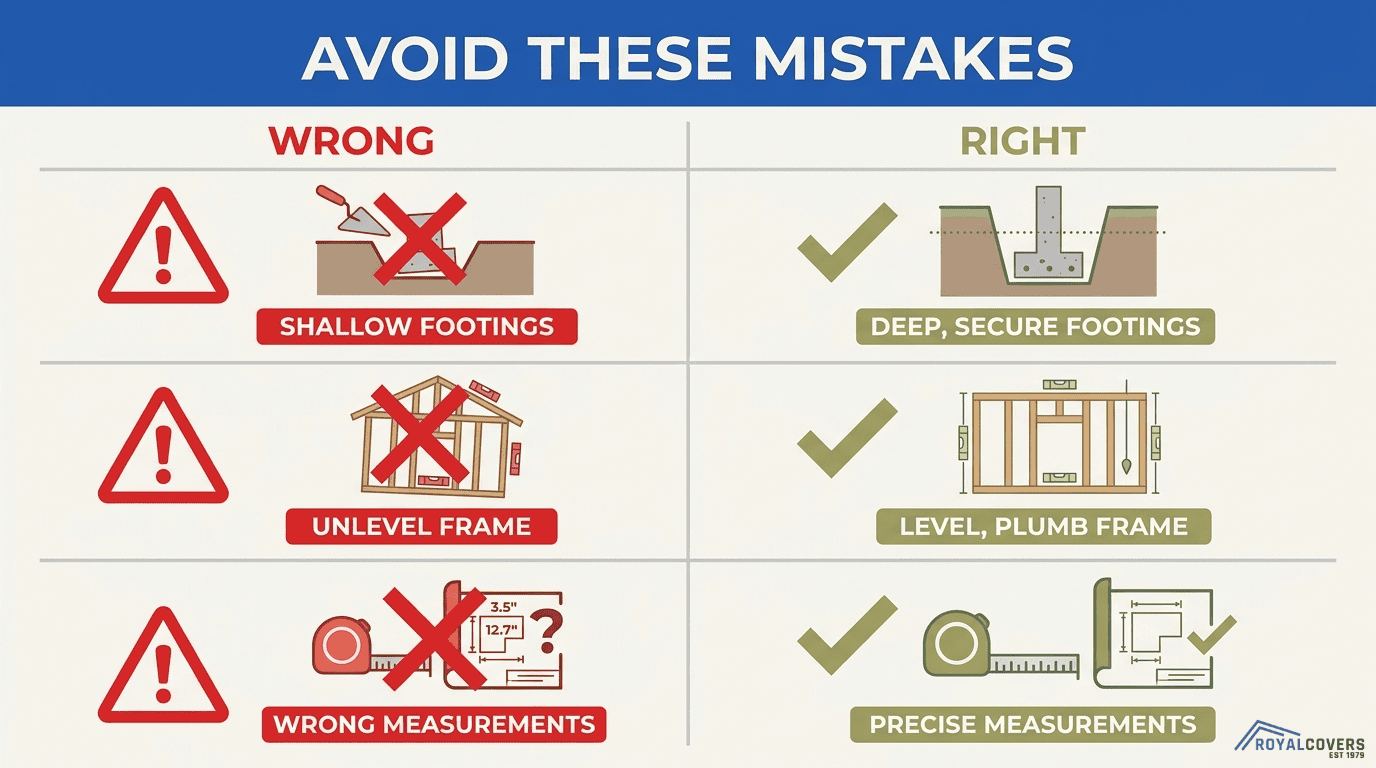
Common installation mistakes with retractable Alumawood pergolas include shallow post footings, an unlevel or out-of-square frame, and incorrect canopy measurements. Each error compromises structural integrity or retractable function.
What Happens if Post Footings Are Too Shallow?
Post footings that are too shallow allow the pergola to shift, lean, or lift under wind and lateral loads. Shallow footings fail to reach stable soil, and in colder regions, footings above the frost line are vulnerable to heave. According to the City of Spokane Valley’s residential patio cover guide, frost line depth may require deeper footings than standard diagrams indicate.
Undersized footings also risk failing a foundation inspection, since inspectors verify trench depth, forms, and reinforcing steel placement before concrete is poured. In loose or expansive soils, this mistake can cause progressive tilting that stresses beam connections and misaligns the retractable track system. Footing depth is not the place to cut corners; when in doubt, exceed the minimum.
What Goes Wrong When the Frame Is Not Level or Square?
An Alumawood frame that is not level or square causes the retractable canopy to bind, skip, or jam along its track rails. Even a quarter-inch deviation across a beam span creates uneven tension on the fabric and accelerates wear on guide rollers or motor components.
Out-of-square corners compound the problem because diagonal measurements will differ, pulling rafters into slight parallelogram alignment. Since Alumawood rafters are normally set 24 inches on center, cumulative offset across multiple bays magnifies tracking errors. Checking level at every post and confirming square with diagonal string measurements before tightening any hardware prevents these cascading issues. A misaligned frame is far harder to correct after the canopy system is mounted.
How Do Incorrect Canopy Measurements Cause Problems?
Incorrect canopy measurements cause problems ranging from incomplete shade coverage to mechanical failure of the retractable system. A canopy cut too wide bunches inside the track rails, while one cut too short leaves exposed gaps and uneven retraction.
Accurate measurement requires accounting for the full rafter span in the projection direction and the post span in the width direction, since these dimensions define the canopy’s travel path. Fabric that does not match these dimensions places asymmetric stress on tensioning hardware, which can strip manual crank gears or overload motorized drive units over time. Always measure the finished frame, not the original design drawings, because field conditions introduce slight variances that factory specs alone cannot predict.
Avoiding these common mistakes protects both the structure and the retractable mechanism, setting the stage for straightforward long-term maintenance.
How Do You Maintain a Retractable Alumawood Pergola After Installation?
You maintain a retractable Alumawood pergola after installation by routinely cleaning the aluminum frame, inspecting the retractable canopy fabric, and servicing the mechanical hardware. The sections below cover frame care and canopy maintenance.
How Do You Clean and Care for the Alumawood Frame?
You clean and care for the Alumawood frame by washing it periodically with mild soap and water, then rinsing thoroughly with a garden hose. Alumawood’s embossed woodgrain finish requires only a fraction of the maintenance that real wood demands, according to Alumawood Outdoor Living. Avoid abrasive cleaners or steel wool, which can scratch the powder-coated surface.
A seasonal maintenance routine keeps the frame performing at its best:
- Inspect all post-to-beam and rafter connections for loose fasteners twice per year.
- Check for any chips or scratches in the finish and touch up with manufacturer-recommended paint.
- Clear debris from beam channels and rafter tops where leaves and dirt accumulate.
- Examine anchor bolts at the base of each post for corrosion or movement.
Because aluminum resists rust and rot naturally, most homeowners find that consistent cleaning alone preserves the frame’s appearance for decades.
How Do You Maintain the Retractable Canopy Fabric and Hardware?
You maintain the retractable canopy fabric and hardware by cleaning the fabric, lubricating moving parts, and inspecting the retraction mechanism each season. According to the Advanced Textiles Association, metal support frames made from aluminum or galvanized steel can last a lifetime when properly maintained.
Key maintenance tasks include:
- Brush loose dirt off the canopy fabric before washing with a mild soap solution; never use bleach or harsh solvents.
- Allow the fabric to dry completely before retracting it to prevent mold and mildew growth.
- Lubricate track rails, guide cables, and roller bearings with a silicone-based spray every six months.
- Test the motorized or manual crank mechanism monthly to confirm smooth, even retraction without binding.
- Inspect fabric tension and edge seams for fraying, and address wear before it spreads.
Retracting the canopy during high winds or heavy storms is one of the simplest ways to extend both fabric and hardware lifespan. With consistent seasonal care, your retractable Alumawood pergola will continue to perform reliably for years.
How Does Climate Affect Retractable Alumawood Pergola Installation?
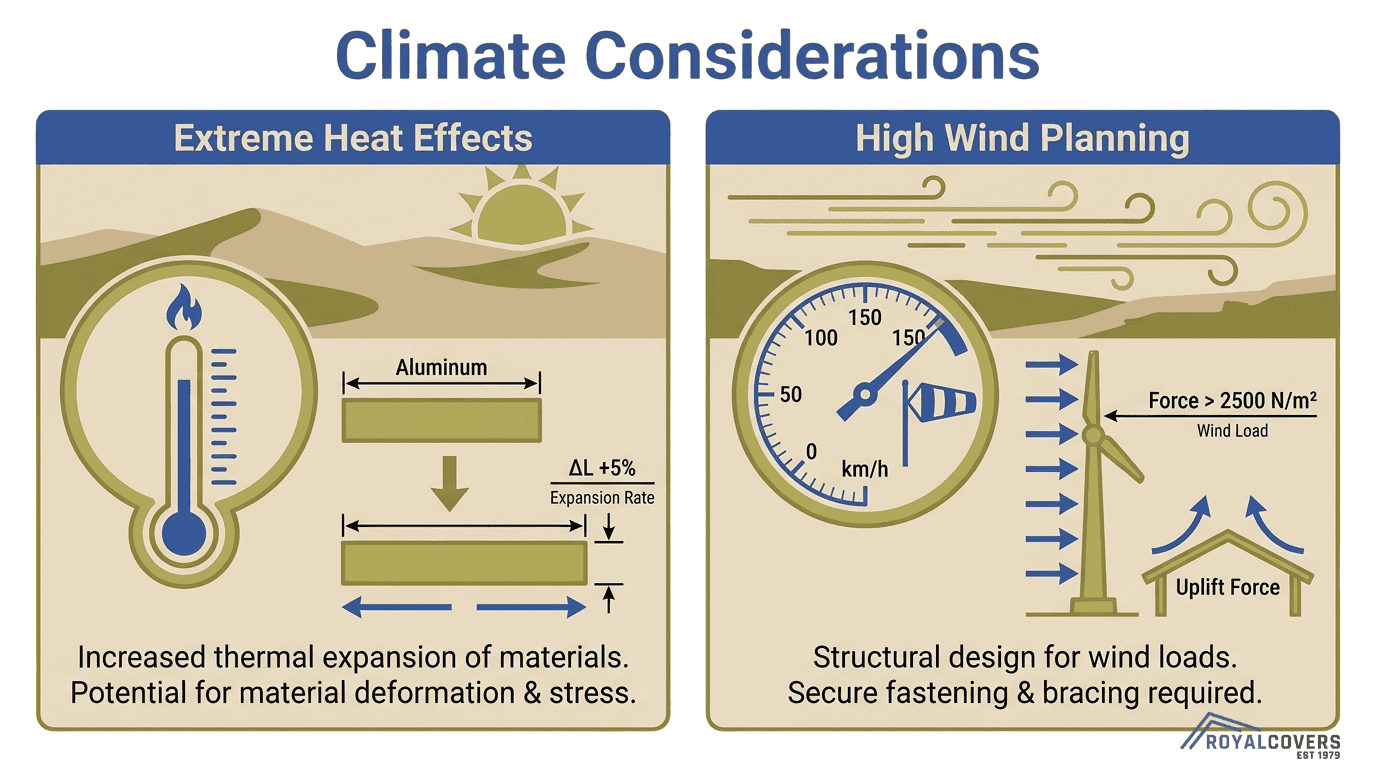
Climate affects retractable Alumawood pergola installation by influencing material behavior, structural requirements, and construction timing. Extreme heat causes aluminum to expand, while high winds demand stronger anchoring and engineering.
How Do You Install a Retractable Alumawood Pergola in Extreme Heat?
You install a retractable Alumawood pergola in extreme heat by accounting for thermal expansion, scheduling work during cooler hours, and protecting both materials and installers. Aluminum expands as temperatures rise, and ignoring this reality leads to warped frames and binding canopy tracks.
According to the National Institute of Standards and Technology, the coefficient of linear expansion of pure aluminum is 23.86 × 10⁻⁶ per °C. On a 20-foot rafter in desert conditions where surface temperatures can exceed ambient air by 30°F or more, that expansion becomes measurable enough to affect fit and function.
To manage heat during installation:
- Schedule assembly for early morning when aluminum components are at their coolest dimensions.
- Allow small gaps at connection points so expanding members do not buckle or bind.
- Hydrate frequently and rotate tasks to reduce heat-related safety risks for installers.
- Store canopy fabric in shade before mounting, since UV-heated fabric stretches unevenly during tensioning.
For anyone installing in the Southwest, thermal expansion is the single most underestimated factor. Getting fastener torque and gap tolerances right in the morning prevents callbacks when afternoon temperatures push materials to their extremes.
How Do You Account for High Winds During Pergola Installation?
You account for high winds during pergola installation by specifying stronger anchoring, tighter rafter spacing, and wind-rated components matched to your local design wind speed. Wind loads place lateral and uplift forces on the structure that standard configurations may not withstand.
The Florida Solar Energy Center notes that installations in high wind speed areas may require higher strength anchoring or reinforcing than would be needed in lower wind speed areas. Local building codes reference wind speed maps from the International Building Code to determine the specific rating your pergola must meet.
Key wind-resistance strategies include:
- Use deeper footings with larger diameter concrete piers to resist uplift and overturning forces.
- Reduce rafter spacing from the standard 24 inches on center to 16 or 12 inches for greater rigidity.
- Select retractable canopy systems rated for your region’s wind classification, and retract the canopy when sustained winds exceed the manufacturer’s threshold.
- Verify that post-to-beam and beam-to-rafter connections use hurricane ties or engineered brackets rather than gravity-only fasteners.
Proper wind planning at the design stage is far less expensive than retrofitting a structure after storm damage. With the right specifications in place, understanding whether to tackle installation yourself or hire a professional becomes the next decision.
Should You DIY or Hire a Professional for Retractable Alumawood Pergola Installation?
You should DIY a retractable Alumawood pergola installation only if the project is simple and you have structural building experience; otherwise, hiring a professional is the safer choice. The sections below break down which tasks demand professional expertise and when a DIY approach makes sense.
What Parts of the Installation Require Professional Expertise?
The parts of the installation that require professional expertise include footing engineering, structural beam connections, motorized canopy wiring, and permit compliance. According to OSHA, falls are the leading cause of death in construction, with 389 fatal falls to a lower level out of 1,034 construction fatalities recorded in 2024. Overhead beam and rafter assembly at height creates serious risk for untrained homeowners.
Specific tasks best left to professionals include:
- Calculating footing depth based on local frost lines and soil conditions.
- Sizing and spacing beams and rafters to meet wind and snow load requirements.
- Installing motorized retractable mechanisms that involve electrical connections.
- Navigating permit applications, site plans, and required inspections.
- Attaching the pergola header to an existing house ledger board safely.
Structural miscalculations compound quickly. A footing that is too shallow or a rafter span that exceeds manufacturer limits can lead to costly teardowns, code violations, or structural failure under wind load. For most homeowners, the complexity of these interconnected tasks makes professional installation the more reliable path.
When Does DIY Retractable Pergola Installation Make Sense?
DIY retractable pergola installation makes sense when the project is a small, freestanding structure and the homeowner has hands-on construction experience. According to the National Association of REALTORS Remodeling Impact Report, 40% of consumers completed their entire outdoor project themselves, including labor and purchasing materials.
A DIY approach is reasonable when:
- The pergola is freestanding and does not attach to the house structure.
- The footprint is small enough to fall below local permit thresholds.
- No electrical wiring is needed for the retractable canopy mechanism.
- The homeowner owns proper tools, including a level, drill, post-hole digger, and concrete mixing equipment.
Even capable DIYers should have the site inspected before pouring footings, since foundation inspections verify that trenches, forms, and reinforcing steel meet code. Skipping this step is one of the most common and most expensive mistakes in pergola projects.
Understanding which tasks require licensed expertise helps you decide how to move forward with your outdoor living project.
How Can Professional Pergola Installation Enhance Your Outdoor Living Space?
Professional pergola installation enhances your outdoor living space by combining custom design, code-compliant construction, and durable materials into a structure built to last. The following sections cover what Royal Covers offers and the key takeaways from this installation guide.
Can Royal Covers Design and Install a Custom Alumawood Pergola for Your Home?
Yes, Royal Covers can design and install a custom Alumawood pergola for your home. Founded in 1979, Royal Covers brings over 45 years of specialized experience building shade structures engineered for desert conditions. Royal Covers offers a product range that includes solid patio covers for full shade, lattice pergolas for filtered sunlight, combination structures, and adjustable louvered roofs, each custom-designed to fit your home’s architecture and backyard dimensions.
Royal Covers handles every phase of the project, from free design consultation through permit acquisition and professional installation. Full-time, continuously trained crews manage footing placement, beam and rafter assembly, and retractable canopy integration. Royal Covers also coordinates HOA approvals and building permits so homeowners avoid code violations. For homeowners who want a pergola that performs reliably in extreme heat and wind, working with a specialist who understands local climate demands is the most practical path to a lasting result.
What Are the Key Takeaways About Retractable Alumawood Pergola Installation?
The key takeaways about retractable Alumawood pergola installation center on preparation, compliance, and material selection:
- Alumawood products use roll-formed and extruded aluminum with an embossed woodgrain finish that requires minimal maintenance compared to natural wood.
- Site preparation requires calling 811 at least two full working days before excavation and verifying that the ground is level and stable.
- Permit requirements vary by jurisdiction; according to the City of Maricopa, pergolas over 200 square feet require a permit, and any pergola with electrical or plumbing needs one regardless of size.
- Footing depth must account for local frost lines and wind load calculations specific to your region.
- Retractable canopy systems offer manual or motorized operation, with fabric tension and track alignment being critical to long-term function.
- Professional installation eliminates the most common failure points, including shallow footings, out-of-square framing, and incorrect canopy measurements.
Prioritizing these fundamentals protects your investment and ensures your outdoor living space delivers comfort for years to come.