
A pergola is a freestanding or attached outdoor structure built with vertical posts, horizontal beams, and open or covered rafters that provide shade and define living space in a backyard. DIY pergola installation follows a sequential process from initial planning through final finishing, and each phase requires specific knowledge to produce a safe, durable result.
This guide covers pre-build preparation, design and planning, site and foundation work, structural framing, finishing and maintenance, and knowing when to hire a professional.
Preparation starts with assembling the right tools, selecting materials suited to your climate, checking local permit requirements, and choosing a location based on sun path, drainage, and utility clearances. Pressure-treated lumber, naturally durable hardwoods, and aluminum systems each serve different budgets and maintenance tolerances.
Design decisions include sizing the pergola to match furniture layout and setback rules, creating a scaled building plan with overhead views and elevation drawings, and selecting a roof style ranging from open-rafter to louvered depending on shade goals and skill level.
Foundation and framing form the structural core. Concrete footings must reach code-required depth, cure properly before posts are set, and provide a complete load path from rafters through posts to the ground. Posts require plumb alignment on two faces, temporary bracing, and correctly rated hardware at every beam and rafter connection.
Finishing transforms a raw frame into a functional space through sanding, sealing, decorative trim, and outdoor lighting or fan installation. Ongoing maintenance, including seasonal hardware inspection, sealant reapplication, and footing checks, preserves structural integrity over the pergola’s lifespan.
Common mistakes such as out-of-plumb posts, skipped footings, and undersized beams create compounding failures that threaten safety. When project complexity exceeds basic carpentry, professional installation eliminates those risks entirely.
What Should You Know Before Starting a DIY Pergola Installation?
Before starting a DIY pergola installation, you should understand the tools required, the best materials for your climate, local permit requirements, and optimal site placement. The following subsections cover each of these preparation essentials.
What Tools and Equipment Do You Need for Pergola Installation?
The tools and equipment you need for pergola installation include both standard hand tools and power tools for cutting, fastening, and leveling. Essential items include:
- A circular saw or miter saw for cutting beams, rafters, and cross slats to length.
- A power drill and impact driver for driving lag bolts, carriage bolts, and structural screws.
- A post hole digger or power auger for excavating footing holes.
- A 4-foot level and a plumb bob for ensuring posts stand perfectly vertical.
- A framing square and tape measure (25-foot minimum) for accurate layout.
- Speed clamps and temporary braces for holding members in position during assembly.
- A ladder rated for your working height plus safety gear, including eye protection, gloves, and hard-soled boots.
According to OSHA, protective equipment for eyes, face, head, and extremities shall be provided and maintained wherever hazards are encountered during construction. Skipping even basic safety gear is one of the most common and preventable mistakes DIY builders make.

What Materials Are Best for Building a DIY Pergola?
The best materials for building a DIY pergola are pressure-treated lumber, naturally durable wood species, and aluminum or steel systems, each offering distinct advantages.
- Pressure-treated southern pine is the most affordable structural option. It resists rot and insects when treated to AWPA Standard U1 specifications, though it requires periodic sealing.
- Naturally durable hardwoods such as cedar, cypress, and white oak contain heartwood extractives that repel fungal decay and insects without chemical treatment, as documented in the University of Tennessee Institute of Agriculture’s guide on wood protection.
- Aluminum pergola systems (such as Alumawood) deliver a wood-grain appearance with virtually zero maintenance, no warping, and no cracking.
For desert climates, aluminum consistently outperforms wood in long-term durability because it resists UV degradation and thermal cycling without staining or resealing.
What Permits or Building Codes Apply to Pergola Construction?
The permits and building codes that apply to pergola construction vary by municipality but generally fall under residential building codes governing structural loads and safety. The 2021 International Residential Code requires that structures safely support all loads, including dead loads, live loads, roof loads, wind loads, and seismic loads, with a complete load path from point of origin through load-resisting elements to the foundation.
Permit requirements depend on your pergola’s size and features:
- Patio covers not exceeding 300 square feet of projected roof area may be exempt from a building permit for single-family and duplex residential structures, according to City of San Diego Development Services Information Bulletin 206.
- Separate electrical, mechanical, and plumbing permits may still be required even when the structure itself is exempt.
- Attached pergolas almost always require a permit because they modify the existing building envelope.
As the National Association of Home Builders notes, building codes profoundly impact both resident safety and construction costs. Always contact your local building department before breaking ground.
How Do You Choose the Right Location for Your Pergola?
You choose the right location for your pergola by evaluating sun exposure, proximity to your home, ground conditions, and utility clearances. Key factors include:
- Sun path orientation: Positioning the long axis east-to-west maximizes midday shade beneath the rafters. Effective shading can block up to 90% of solar heat gain, according to the Australian Government’s YourHome passive design guide.
- Ground conditions: Level, well-drained soil simplifies footing installation. Avoid areas where water pools after rain, as saturated soil weakens concrete footings over time.
- Setback requirements: Most jurisdictions enforce property line setbacks for accessory structures; verify these before committing to a layout.
- Utility lines: Call 811 to mark underground gas, water, and electrical lines before digging any post holes.
A pergola placed too far from the house often goes underused, while one connected to a back door or kitchen exit naturally extends your living space. With the right location selected, you can move forward into detailed planning and design.
How Do You Plan and Design Your Pergola Before Building?
You plan and design your pergola before building by determining the right size, creating a detailed building plan, and selecting a roof style. These three decisions shape every subsequent construction step.
What Size Pergola Should You Build for Your Outdoor Space?
The size pergola you should build for your outdoor space depends on the area’s intended use, available yard dimensions, and local setback requirements. A dining setup for six typically needs a minimum footprint of 10 by 12 feet, while a lounge area may require 12 by 16 feet or larger.
Before committing to dimensions, consider these factors:
- Furniture layout: Measure all planned furniture and add at least two feet of clearance on each side for comfortable movement.
- Post height: Standard pergola height ranges from 8 to 10 feet, which affects both shade angles and visual proportion relative to the footprint.
- Property setbacks: Most jurisdictions require structures to sit a minimum distance from property lines, so verify local zoning rules before finalizing your footprint.
Oversizing adds unnecessary material cost; undersizing creates a cramped, underused structure. Matching the pergola’s scale to its function is one of the most practical decisions in the entire project.
How Do You Read and Create a Pergola Building Plan?
You read and create a pergola building plan by learning standard architectural symbols for dimensions, elevations, and material callouts, then drafting your own layout to scale. According to the American Iron and Steel Institute, all major building system manufacturers utilize CADD tools to custom design structures and all building components, a practice DIY builders can replicate with free design software.
A functional pergola plan includes:
- Overhead view showing post locations, beam spans, and rafter spacing.
- Elevation drawings indicating post height, beam depth, and roof pitch.
- Materials list specifying lumber dimensions, hardware quantities, and concrete volume for footings.
Even a hand-drawn plan on graph paper works if drawn to consistent scale and reviewed before purchasing materials.
What Roof Style Should You Choose for a DIY Pergola?
The roof style you should choose for a DIY pergola depends on your shade goals, skill level, and climate. According to Australia’s YourHome guide on passive design, effective shading can block up to 90% of solar heat, making roof style a critical performance decision.
Common pergola roof styles include:
- Open-rafter: Evenly spaced rafters with no covering, providing partial filtered shade and maximum airflow.
- Lattice top: Crossed slats layered over rafters for denser shade patterns while still allowing light penetration.
- Solid panel: Polycarbonate or metal panels installed over rafters for full weather protection, though these require proper drainage slope.
- Louvered: Adjustable slats that rotate to control sunlight throughout the day.
For most DIY builders, open-rafter and lattice designs offer the simplest construction with the fewest waterproofing concerns. With your plan and roof style finalized, the next step is preparing your site and foundation.
How Do You Prepare the Site and Foundation for a Pergola?
You prepare the site and foundation for a pergola by clearing vegetation, leveling the ground, digging footing holes to code depth, and pouring concrete piers. The subsections below cover ground preparation, concrete footing installation, and proper cure times.
How Do You Level and Clear the Ground for Pergola Footings?
You level and clear the ground for pergola footings by removing all vegetation, debris, and loose soil from the build area, then grading the surface to a uniform plane. Start by marking the pergola’s footprint with stakes and string lines, confirming square corners with the 3-4-5 triangle method.
Key ground preparation steps include:
- Remove sod, roots, rocks, and any organic material within the layout area.
- Grade the soil so water drains away from the planned structure, maintaining a slight slope of 1–2% from the house.
- Compact loose or disturbed soil with a hand tamper or plate compactor to prevent future settling.
- Verify level across all footing locations using a long spirit level or laser level.
Skipping proper ground preparation is one of the most common causes of uneven posts and long-term structural drift. Spending time here saves significant rework later.
How Do You Dig and Pour Concrete Footings for Pergola Posts?
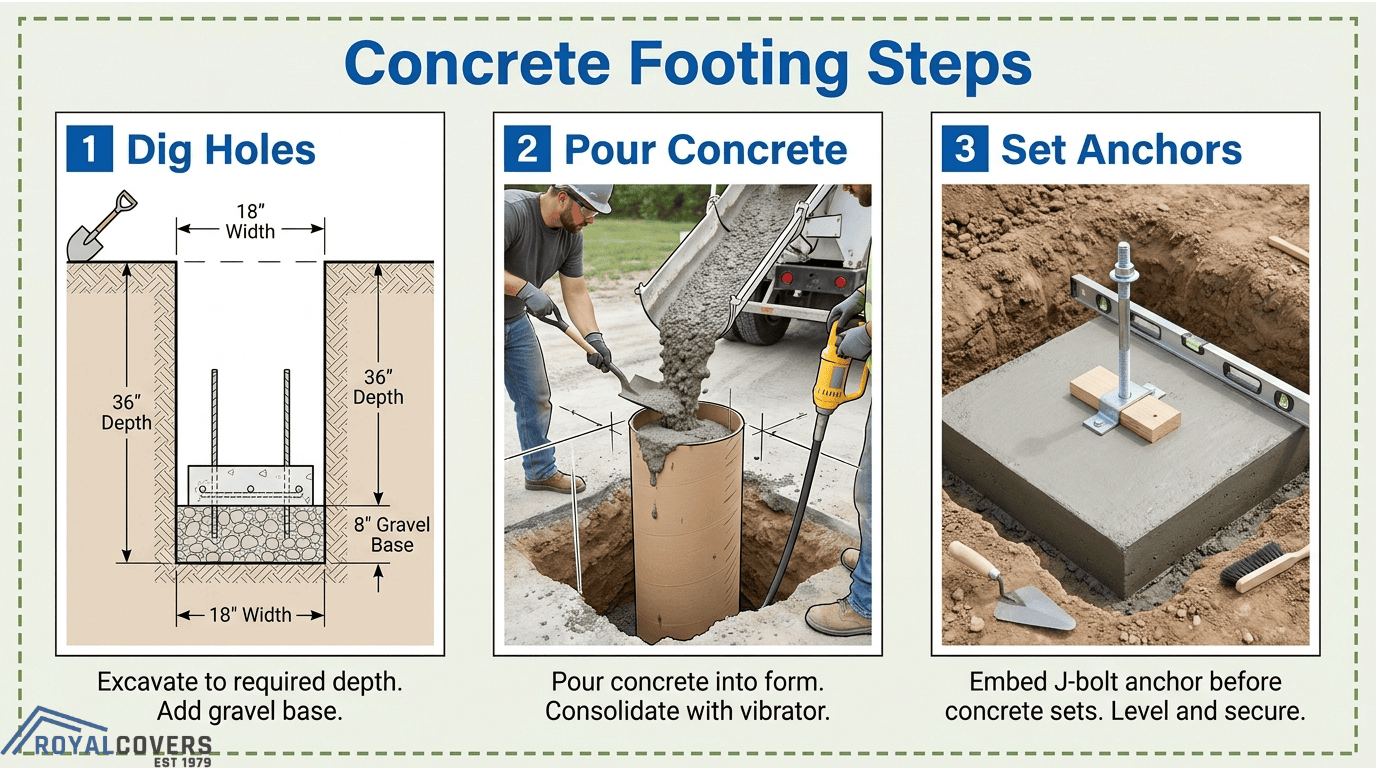
You dig and pour concrete footings for pergola posts by excavating holes to the depth required by local code, inserting post anchors or tubes, and filling with mixed concrete. Most jurisdictions require footings that extend below the frost line, which varies by region.
Follow this sequence for each footing:
- Dig holes at least 12 inches in diameter and to the locally required depth, typically 18–48 inches depending on frost line and soil conditions.
- Add 2–3 inches of compacted gravel at the bottom for drainage.
- Insert a cardboard tube form (such as a sonotube) to shape the concrete above grade and prevent soil contamination.
- Pour pre-mixed concrete into the form, overfilling slightly.
- Set a metal post anchor or J-bolt into the wet concrete, aligning it precisely with your string layout lines.
According to the 2021 International Residential Code (Chapter 3), structures must provide a complete load path transferring all loads from their point of origin through load-resisting elements to the foundation. Properly sized and placed footings are the base of that load path.
How Long Should Concrete Footings Cure Before Installing Posts?
Concrete footings should cure for a minimum of 48 hours before installing posts, though a full 7-day cure is recommended for footings that will bear significant structural load. Standard concrete reaches approximately 70% of its rated compressive strength within 7 days and near-full strength at 28 days.
Factors that affect cure time include:
- Ambient temperature: Cold weather slows curing; cover footings with insulating blankets if temperatures drop below 50°F.
- Humidity and moisture: Keep the concrete surface damp during the first few days to prevent surface cracking from rapid evaporation.
- Concrete mix type: Fast-setting mixes may allow post installation within 4–6 hours for lighter loads, but standard mixes need longer.
Rushing this step compromises the entire structure. Posts mounted on under-cured concrete can shift under load, creating alignment problems that cascade through beams and rafters. With footings fully cured, the next phase of setting and plumbing the pergola posts can begin.
What Are the Steps to Install Pergola Posts?
The steps to install pergola posts depend on your material type and mounting surface. The process covers setting wood posts, installing aluminum or metal posts, anchoring to existing concrete, and bracing for plumb alignment.
How Do You Set and Plumb Wood Pergola Posts?
You set and plumb wood pergola posts by placing them into concrete footings and verifying vertical alignment on two adjacent faces before the concrete cures. According to the American Wood Council’s Prescriptive Residential Wood Deck Construction Guide, the minimum post size for structural applications is 6×6 nominal.
The process follows this sequence:
- Position the post in the center of the wet footing or into a post base anchor embedded in cured concrete.
- Hold a 4-foot level against two adjacent sides, checking plumb on each face independently.
- Have a helper adjust the post while you read the level.
- Secure temporary braces at 90-degree angles to lock the post in position.
- Recheck plumb after bracing, since fastening braces can shift alignment.
For most DIY builders, using post base brackets on cured footings provides more adjustment time than setting posts directly in wet concrete.
How Do You Set and Plumb Aluminum or Metal Pergola Posts?
You set and plumb aluminum or metal pergola posts by bolting pre-fabricated base plates to concrete footings or anchors, then shimming for precise vertical alignment. Metal posts offer tighter tolerances than wood because they are factory-milled to consistent dimensions.
Key installation steps include:
- Position the base plate over anchor bolts embedded in the cured footing.
- Thread nuts onto the bolts finger-tight, leaving room for adjustment.
- Place a level on two faces and insert stainless steel shims under the base plate to correct any lean.
- Tighten bolts in a star pattern to distribute clamping force evenly.
- Verify plumb one final time after full torque is applied.
Aluminum posts, being lighter than steel, are easier to handle solo but still benefit from temporary bracing until beams are attached.
How Do You Anchor Pergola Posts to an Existing Concrete Patio?
You anchor pergola posts to an existing concrete patio by drilling into the slab and securing post base hardware with mechanical or chemical anchors. This surface-mount approach eliminates the need for separate footings when the existing slab meets minimum thickness requirements, typically four inches for residential patios.
The anchoring process includes:
- Mark post locations on the slab using your pergola layout dimensions.
- Drill holes with a hammer drill and masonry bit sized to your anchor specification.
- Clear dust from each hole using compressed air or a vacuum.
- Insert wedge anchors or inject epoxy followed by threaded rod, depending on your chosen system.
- Attach the post base bracket and torque bolts to manufacturer specifications.
Chemical anchors generally provide stronger pull-out resistance in older or partially weathered concrete compared to mechanical wedge anchors alone.
How Do You Brace Posts to Keep Them Straight During Installation?
You brace posts to keep them straight during installation by attaching temporary diagonal supports on two perpendicular sides of each post. Bracing prevents movement from wind, accidental contact, or the weight of beams and rafters being added overhead.
Effective bracing requires:
- Attach one brace running from the post to a stake driven into the ground, positioned at roughly 45 degrees.
- Attach a second brace at 90 degrees to the first, creating two-axis stabilization.
- Use clamps or screws at the post connection point for easy removal later.
- Leave braces in place until all beams and at least half the rafters are fastened, since the completed frame provides its own lateral rigidity.
Removing braces too early is one of the most common DIY mistakes; the structure needs enough connected members to resist racking forces before temporary supports come off. With posts secured and braced, the next step is attaching beams and support headers to form the pergola frame.
How Do You Attach Pergola Beams and Support Headers?
You attach pergola beams and support headers by measuring precisely, selecting appropriate hardware, and lifting each beam into position on plumbed posts. The following subsections cover measuring and cutting, choosing fasteners, and safely securing beams.
How Do You Measure and Cut Beams for a Pergola Frame?
You measure and cut beams for a pergola frame by referencing your building plan dimensions and marking each beam for consistent length and overhang. Start by measuring the distance between the outer edges of your posts, then add the desired overhang on each side. Transfer measurements with a carpenter’s square and mark cut lines clearly on all four faces of the beam.
For clean, straight cuts on 2×8 or 2×10 lumber, use a circular saw with a speed square as a guide, finishing the cut on the opposite face if the blade cannot pass through in one pass. Double-check every beam against the first cut piece rather than re-measuring independently; this prevents cumulative errors from compounding across the frame.
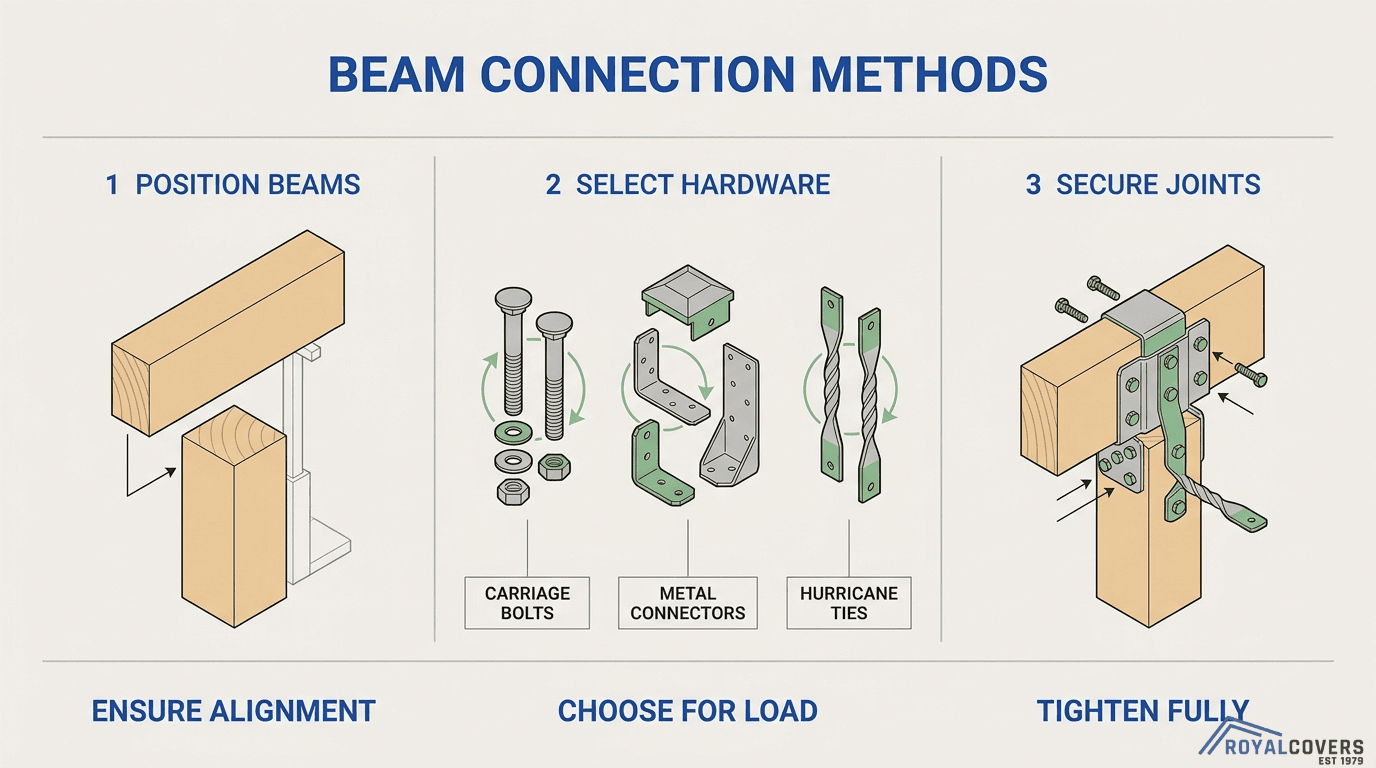
What Fasteners and Hardware Work Best for Beam Connections?
The fasteners and hardware that work best for beam connections include galvanized or stainless steel through-bolts, structural screws, and post-to-beam metal connectors. Through-bolts with washers distribute load evenly across the joint, while engineered metal connectors such as post caps and saddle brackets add lateral stability.
Key hardware options for beam-to-post joints include:
- Galvanized carriage bolts (1/2-inch diameter) secure beams through posts with high shear resistance.
- Structural timber screws offer faster installation than bolts while maintaining strong withdrawal strength.
- Post cap connectors wrap the top of each post and cradle the beam, resisting uplift forces.
- Hurricane ties or seismic clips provide additional resistance to wind and lateral loads.
Always match hardware to the treatment chemistry of your lumber; standard galvanized fasteners corrode when paired with certain pressure-treated wood preservatives.
How Do You Safely Lift and Secure Beams to the Posts?
You safely lift and secure beams to the posts by using at least two people, temporary supports, and a systematic fastening sequence. Beams for a standard pergola can weigh 50 pounds or more, making solo lifting both difficult and dangerous. According to the National Institute for Occupational Safety and Health, workers are exposed to fall risks during construction of buildings, so proper precautions on ladders and scaffolding are essential.
Follow these steps to position each beam:
- Set up sturdy A-frame ladders on level ground at each post location.
- Lift the beam together, resting each end on its respective post top.
- Clamp the beam temporarily with C-clamps to hold it in position.
- Check level across the full span and adjust shims if needed.
- Drill pilot holes and install permanent bolts or connectors.
Never release the clamps until at least two permanent fasteners are fully tightened on each joint. With beams secured, the frame is ready for rafters and cross slats.
How Do You Install Pergola Rafters and Cross Slats?
You install pergola rafters and cross slats by spacing rafters evenly across the support beams, cutting decorative ends, fastening each rafter securely, and then layering top slats or lattice for shade.
What Spacing Should You Use Between Pergola Rafters?
The spacing you should use between pergola rafters is typically 12 to 16 inches on center for a balanced look with adequate shade coverage. Wider spacing, around 24 inches, allows more sunlight and creates an airier feel, while tighter spacing increases shade density. The right choice depends on your local climate, rafter lumber size, and how much filtered light you want beneath the structure.
- 12-inch spacing provides the most shade and works well in hot, sun-intense climates.
- 16-inch spacing offers a standard balance between shade and airflow.
- 24-inch spacing suits decorative pergolas where open sky visibility matters more than sun protection.
For regions with extreme heat, closer rafter spacing is almost always the better investment; the incremental material cost is small compared to the comfort gained underneath.
How Do You Cut Decorative Rafter Tail Ends?
You cut decorative rafter tail ends by marking a design template on each rafter’s exposed end and cutting along the line with a jigsaw or reciprocating saw. Common tail-end profiles include:
- Curved or scalloped cuts for a classic, traditional appearance.
- Angled or mitered cuts for a clean, modern look.
- Notched or stepped cuts for a craftsman-style detail.
Create a single template from plywood or cardboard first, then trace it onto every rafter to ensure uniformity. Clamp the rafter securely before cutting, and sand each cut edge smooth to prevent splintering. Consistent tail ends are one of the most visible design elements on a finished pergola, so taking time here pays off in curb appeal.
How Do You Fasten Rafters to the Support Beams?
You fasten rafters to the support beams using hurricane ties, structural screws, or galvanized rafter-to-beam connectors. Each method secures the rafter against lateral movement and uplift loads.
- Hurricane ties (metal rafter connectors) wrap around the rafter and nail into the beam, providing the strongest uplift resistance.
- Structural lag screws or timber screws driven at an angle (toenailing) offer solid holding power with a cleaner look.
- Notched seat cuts allow rafters to sit into the beam, adding a gravity lock before fasteners are applied.
According to the 2021 International Residential Code (Chapter 3), structures must provide a complete load path transferring loads from their point of origin through load-resisting elements to the foundation. Properly rated connectors ensure your rafter-to-beam joints contribute to that continuous load path.
How Do You Add Top Slats or Lattice for Shade Coverage?
You add top slats or lattice for shade coverage by fastening narrower boards or pre-made lattice panels perpendicular to the rafters across the top of the pergola frame. Slats are typically 1×2 or 2×2 lumber spaced 1 to 3 inches apart, while lattice panels come in prefabricated sheets that can be cut to fit.
- Closer slat spacing (1 inch apart) blocks more sunlight and suits harsh climates.
- Wider slat spacing (3 inches apart) creates a dappled light pattern ideal for milder conditions.
- Lattice panels install quickly and deliver uniform filtered shade with minimal measuring.
Secure each slat or panel with exterior-grade screws driven into the rafters below. Effective shading can block up to 90 percent of direct solar heat, according to the Australian Government’s YourHome passive design guide. With shade coverage complete, the finishing steps bring your pergola build to a polished close.
What Finishing Steps Complete a DIY Pergola Build?
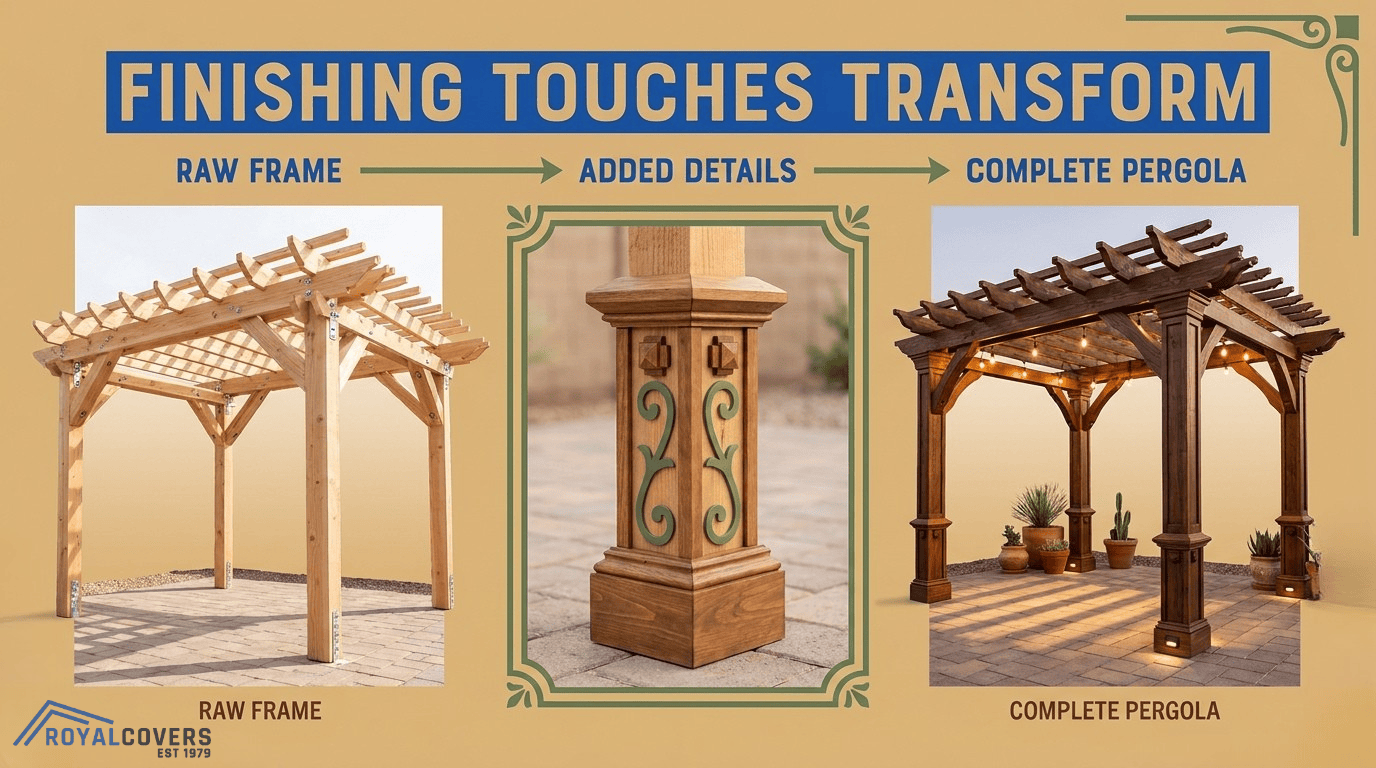
The finishing steps that complete a DIY pergola build include sanding and sealing the wood, adding post trim and decorative details, and installing lighting or fans for functionality.
How Do You Sand and Seal a Wood Pergola After Assembly?
You sand and seal a wood pergola after assembly by first smoothing all surfaces with medium-grit sandpaper (80–120 grit), then progressing to fine-grit (150–220) for a refined finish. Focus on cut ends, drill holes, and beam joints where rough fibers collect moisture.
After sanding, remove all dust with a tack cloth or blower. Apply a penetrating wood sealer or stain formulated for exterior use; the USDA Forest Service’s Wood Handbook notes that naturally durable species like cedar and cypress contain extractives that repel decay, but even these benefit from a quality sealant. Brush sealant into end grain generously, as this is where water infiltration begins. Allow full cure time before placing furniture or accessories underneath.
How Do You Add Post Trim and Decorative Details?
You add post trim and decorative details by wrapping pergola posts with trim boards, installing decorative post caps, or attaching ornamental brackets at beam-to-post connections. These elements conceal hardware and create a polished, architectural look.
Common decorative additions include:
- Post wraps or collars that hide base hardware and anchor bolts.
- Decorative end cuts on rafter tails, such as curved, angled, or scrolled profiles.
- Corbels or knee braces mounted beneath beams for visual weight and subtle lateral support.
- Post caps in copper, wood, or solar-powered styles that crown each column.
Pre-drill all trim fastener holes to prevent splitting. For the cleanest result, use stainless steel or coated screws that match the pergola’s finish.
How Do You Install Lighting or Fans on a Pergola?
You install lighting or fans on a pergola by first determining whether you need low-voltage wiring or a standard 120V electrical circuit. Low-voltage LED string lights and solar fixtures require no permit, while hardwired ceiling fans and sconce lights typically require a dedicated circuit run by a licensed electrician in compliance with NFPA 70 (the National Electrical Code).
The U.S. Department of Energy notes that LEDs save significant energy for outdoor fixtures left on for extended periods and are tested to withstand rain and snow. Popular pergola lighting options include:
- LED string lights draped between rafters for ambient glow.
- Recessed or flush-mount fixtures attached to beams.
- Outdoor-rated ceiling fans with damp or wet location ratings.
All outdoor wiring should use weatherproof junction boxes and GFCI-protected outlets. With lighting and fans in place, the pergola becomes a fully functional outdoor living space.
What Common DIY Pergola Mistakes Should You Avoid?
The most common DIY pergola mistakes involve out-of-plumb posts, missing concrete footings, and undersized structural members. Each of these errors compromises safety, longevity, and appearance.
What Happens If Pergola Posts Are Not Plumb or Level?
Pergola posts that are not plumb or level create compounding structural problems throughout the entire frame. Even a small deviation at the base amplifies over the height of the post, causing beams and rafters to sit unevenly. This misalignment transfers loads asymmetrically, stressing fastener connections and weakening joints over time.
Visible signs include:
- Gaps between beams and post tops where hardware cannot seat flush.
- Rafters that slope noticeably to one side.
- Increasing wobble or sway under wind loads.
Checking plumb with a 4-foot level on two adjacent faces of each post before securing braces prevents these cascading issues. For most DIY builders, rechecking after each footing cures is the single most effective quality control step.
Why Is Skipping Concrete Footings a Structural Risk?
Skipping concrete footings is a structural risk because posts lack a stable base to resist lateral and vertical forces. Without footings, soil movement from moisture cycles, frost heave, or erosion shifts posts out of position. The 2021 International Residential Code requires a complete load path transferring all loads, including wind and seismic forces, from their point of origin through load-resisting elements to the foundation.
Surface-set posts also fail to resist uplift during high winds. Concrete footings anchor posts below the frost line, distributing weight across a broader soil area and preventing settling. For most residential pergolas, footings measuring 12 inches in diameter and 24 to 36 inches deep provide adequate resistance, though local codes may specify exact dimensions.
How Do Undersized Beams or Rafters Compromise a Pergola?
Undersized beams or rafters compromise a pergola by allowing excessive deflection under load. When lumber cross-sections are too small for the span, the wood bends visibly, fasteners loosen, and connections eventually fail. According to the American Wood Council’s Prescriptive Residential Wood Deck Construction Guide, the minimum post size is 6×6 nominal, with maximum heights governed by span tables specific to species and grade.
Common undersizing mistakes include:
- Using 2×6 beams on spans exceeding 8 feet without intermediate support.
- Spacing rafters too far apart for the selected lumber dimension.
- Ignoring the cumulative dead load of roofing materials, lighting, and hanging plants.
Matching each member’s size to published span tables for its species and grade prevents premature sagging and potential collapse. Understanding these structural pitfalls makes ongoing maintenance far more straightforward.
How Do You Maintain a Pergola After Installation?
You maintain a pergola after installation by following a consistent schedule of cleaning, inspection, and protective treatment tailored to the structure’s material. Key maintenance tasks include:
- Inspect hardware seasonally. Check all bolts, screws, and brackets for looseness or corrosion every three to four months, tightening or replacing fasteners before minor issues become structural problems.
- Clean the surface regularly. Wash wood pergolas with a mild soap-and-water solution at least twice a year to remove dirt, mildew, and pollen. Aluminum or vinyl structures need only a rinse with a garden hose and occasional spot cleaning.
- Reapply sealant or stain on wood. Wood pergolas require a fresh coat of UV-resistant sealant or stain every one to three years, depending on sun exposure and climate severity. Skipping this step accelerates cracking, warping, and rot.
- Check posts and footings for shifting. Verify that posts remain plumb and that concrete footings show no signs of heaving or settling, especially after freeze-thaw cycles or heavy storms.
- Trim surrounding vegetation. Keep vines, branches, and climbing plants pruned so they do not trap moisture against the frame or add excessive weight to rafters and cross slats.
- Address rust or oxidation on metal components. Sand small rust spots on steel hardware promptly and apply a rust-inhibiting primer. Aluminum pergolas resist corrosion naturally, though powder-coated finishes benefit from periodic wax application.
Low-maintenance materials like aluminum significantly reduce long-term upkeep compared to untreated wood. For homeowners who want to avoid recurring maintenance altogether, professionally engineered structures built from corrosion-resistant materials offer the most practical solution over a pergola’s lifespan.
When Should You Hire a Professional Instead of DIY?
You should hire a professional instead of DIY when a pergola project involves complex engineering, permit requirements, or structural challenges beyond basic carpentry. The sections below cover how Royal Covers elevates outdoor spaces and the key takeaways from this guide.
How Can Royal Covers Custom Pergola Installation Elevate Your Outdoor Space?
Royal Covers custom pergola installation can elevate your outdoor space by combining desert-engineered materials, professional design, and expert craftsmanship that DIY projects rarely match. Founded in 1979, Royal Covers brings over 45 years of experience building shade structures specifically for Arizona’s extreme climate.
Royal Covers offers several advantages over a DIY approach:
- Alumawood pergolas and lattice covers resist warping, cracking, and fading without the maintenance wood demands.
- Equinox louvered roof systems provide adjustable shade and rain protection with motorized or manual control.
- Full-time, continuously trained installation teams ensure plumb posts, proper load paths, and code-compliant connections.
- Royal Covers handles permits and HOA approvals, removing paperwork from the homeowner’s responsibilities.
Every project begins with a free on-site design consultation tailored to the client’s space. For homeowners who want a structure built right the first time, professional installation eliminates the structural risks outlined throughout this guide.
What Are the Key Takeaways About DIY Pergola Installation We Covered?
The key takeaways about DIY pergola installation we covered span planning, building, and long-term care. Successful pergola construction depends on making informed decisions at every stage.
- Check local building codes and permits before breaking ground; some patio covers under 300 square feet may be exempt, but electrical and mechanical permits can still apply.
- Choose pressure-treated lumber or naturally durable species rated for ground contact and outdoor exposure.
- Pour concrete footings to the depth your frost line and soil conditions require, and allow full curing before setting posts.
- Use minimum 6×6 nominal posts, plumb each one carefully, and brace until beams are secured.
- Size beams and rafters to handle dead loads, live loads, and wind loads across the full span.
- Seal or stain wood promptly after assembly to protect against moisture, UV damage, and decay.
When complexity exceeds your skill level, partnering with a licensed professional protects both your investment and your safety.